
What external quality assessment is
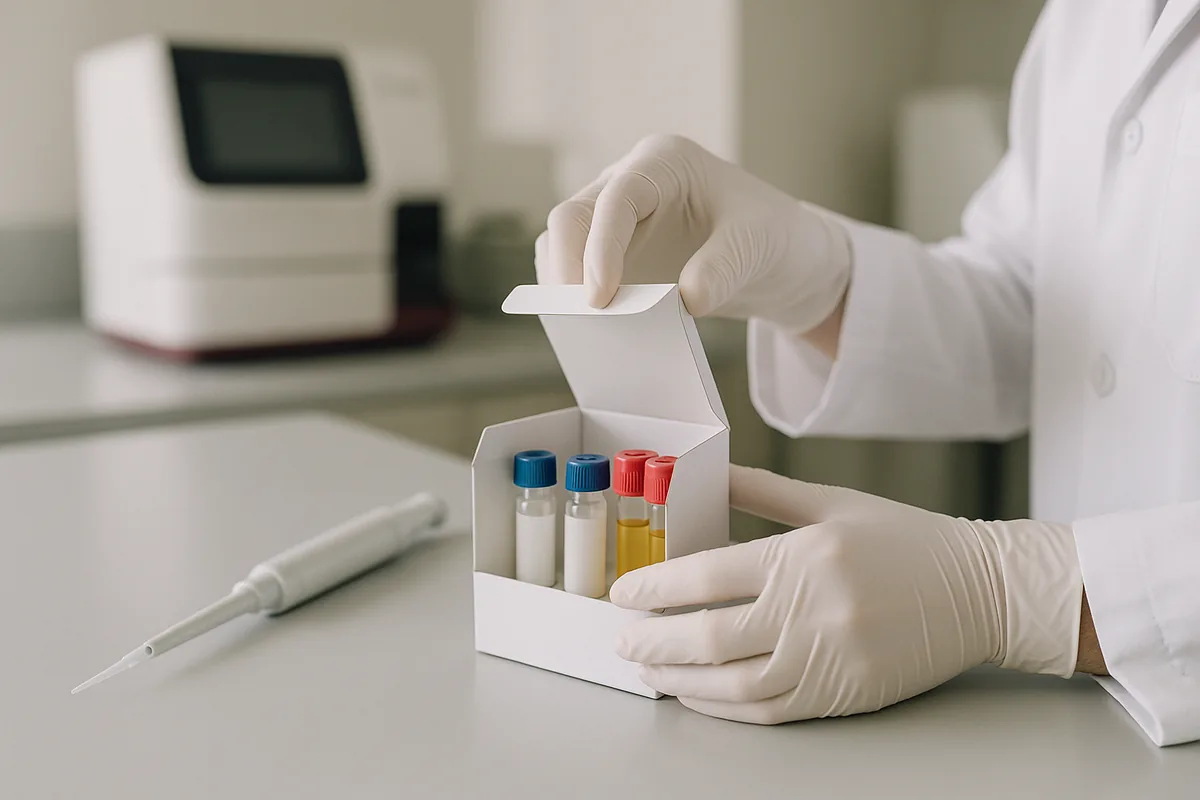
Brazil's RDC 978/2025 defines external quality assessment (EQA, called CEQ in Brazil) as the determination of the accuracy and performance of the analytical process through interlaboratory comparisons conducted by a proficiency testing provider (Art. 5, item X). In practice, the laboratory receives samples of unknown content, analyzes them in the routine and sends the results to the provider, which compares them with an assigned value and with the results of the other participants.
The provider must be accredited to ISO/IEC 17043 (Art. 5, item XXXIX). In Brazil, providers include PNCQ and Controllab, each with its own calendar, form and evaluation criteria.
EQA does not replace internal quality control (IQC). IQC follows the stability of the analytical system at every run; EQA verifies, at the intervals set by the program, whether the laboratory's results agree with those of other laboratories or with a reference value. The relationship between the two is detailed in how EQA and IQC complement each other.
What RDC 978/2025 requires of EQA
The resolution treats EQA as a mandatory part of quality control management. The core requirements are in Arts. 185 to 189 and are complemented by the rules on execution and documentation.
| Article | What it establishes |
|---|---|
| Art. 172 | Quality control management comprises, at a minimum, IQC and EQA. |
| Art. 173 | IQC and EQA must be performed exclusively at the service that performs the tests, and performing them outside the establishment is prohibited. |
| Art. 185 | Every service that performs clinical laboratory tests must take part in EQA programs. |
| Art. 186 | Participation must be individual for each service. |
| Arts. 187 and 188 | EQA must be performed on all instruments in use and for all analytes tested. |
| Art. 189 | The service must verify, at least annually, the availability of proficiency testing for its tests. For tests not covered, it must adopt alternative ways of assessing accuracy described in the scientific literature. |
| Art. 176, item V | The documentation includes the EQA performance report issued by the provider, at least annually, for tests that use commercial control samples. |
| Arts. 115 and 117 | Proficiency testing records must be up to date and available and be kept for at least five years. |
Art. 87 adds that the effectiveness of quality control management must be monitored by the technical manager through performance indicators. The EQA result is one of the most direct pieces of evidence of that effectiveness. For the full picture of the regulation, see what changes in quality control with RDC 978/2025.
What PALC, DICQ and ISO 15189 add
Accreditation standards start from the same basis, but detail how participation should take place and what evidence the assessor expects to find.
PALC 2021 standard (SBPC/ML)
- Take part actively and continuously in at least one external quality assessment program offered by a qualified provider, in all the assays available for the laboratory's test menu (requirement 11.11).
- Handle and analyze the materials in the same way, on the same analytical systems and by the same people who analyze client samples. Do not use results obtained at a reference laboratory, at another processing unit or by consulting other laboratories (11.12).
- Review the reports critically with the team involved and record the evaluation. Unacceptable results require root cause investigation, corrective action and analysis of effectiveness; trends must be evaluated and preventive actions planned (11.13).
- Keep individual participation for each unit that performs tests (11.14).
- For analytes without an available program, keep a documented alternative external assessment, with defined acceptability limits, criteria and frequency, also reviewed critically (11.15 and 11.16).
SNA-DICQ accreditation manual (8th edition)
- Take part effectively in an EQA program and be evaluated in all the analytes the laboratory performs, provided the provider has a sample available (5.6.3.1).
- Establish alternative quality control, whenever possible, when no sample is available (5.6.3.2).
- Analyze EQA samples through the same processes as client samples, without distinction; the evidence requested includes the raw analysis data (5.6.3.3).
- Evaluate the reports with the laboratory director, the person responsible for quality assurance and the professionals who performed the tests, recording causes and actions. Unacceptable results require corrective or preventive actions (5.6.3.4).
ISO 15189:2022
Clause 7.3.7.3 requires the laboratory to monitor the performance of its methods by comparison with other laboratories, in programs appropriate to the examinations, with samples processed by the staff who perform the routine. When no program is available or suitable, the laboratory must use alternative approaches, justify them and demonstrate their effectiveness. When the criteria are not met, handling follows the requirements for nonconforming work (7.5) and corrective action (8.7), which include assessing the impact on results already released.
| Topic | RDC 978/2025 | PALC 2021 | DICQ, 8th ed. | ISO 15189:2022 |
|---|---|---|---|---|
| Participation in an EQA program | Art. 185 | 11.11 | 5.6.3.1 | 7.3.7.3 |
| All analytes and instruments | Arts. 187 and 188 | 11.11 | 5.6.3.1 | 7.3.7.3 |
| Individual participation | Art. 186 | 11.14 | — | — |
| Analysis like patient samples | Art. 173 | 11.12 | 5.6.3.3 | 7.3.7.3 |
| Critical review, cause and corrective action | Art. 87 | 11.13 | 5.6.3.4 | 7.3.7.3 e 8.7 |
| Tests without an available program | Art. 189 | 11.15 e 11.16 | 5.6.3.2 | 7.3.7.3 |
| Records | Arts. 115, 117 and 176 | 11.13 | 5.6.3.4 | 8.4 |
The table summarizes the editions cited. Accreditation standards are revised periodically: confirm the requirements in the current edition and in the scope of your laboratory accreditation process.
How to run a round, step by step
- Plan the year. Compare the program scope with the test menu and the instruments in use, record the kit shipping calendar and the response deadlines, and identify the analytes without coverage.
- Receive the kit. Record the date, the transport condition and the integrity of the samples. Report a damaged kit, or one not received, to the provider within the program's deadline.
- Analyze it as routine. Prepare the samples according to the provider's instructions and analyze them in the normal workflow, by the same analysts and on the same instruments. Do not repeat the analysis more often than you would for a patient sample.
- Check before submitting. Another person compares the instrument result with what will be typed into the form: unit, decimal places, sample identification, method and instrument reported.
- Submit on time and keep the receipt. Record the channel, the protocol and the values sent. A correction after submission must follow the provider's rules and be recorded with its reason.
- Review the evaluation. Check the comparison group, the assigned value, the criterion applied and the result for each analyte, and record the critical review with the team.
- Act on unacceptable results. Investigate the root cause, assess the impact on patient results, define the corrective action and verify its effectiveness in the following rounds.
- Close the cycle. Follow participation and the acceptable rate over the program year, keep the certificate and use the data in the annual performance report.
How to read the provider's report
Before looking at the grade, check the basis of the comparison. Many unacceptable evaluations with no analytical origin start here.
- Assigned value: it may come from the consensus of participants, overall or within the same method group, from a reference method or from the certified value of the material. Consensus values from groups with few participants are less robust.
- Comparison group: the method, reagent and instrument declared at enrollment define who the result is compared with. Outdated enrollment data may produce an unacceptable evaluation without any analytical error.
- Evaluation criterion: z-score, deviation index, a fixed limit around the target or an acceptance range. Each program defines its own, and the official grade is always the provider's.
The most common measures
| Measure | Calculation | Usual interpretation |
|---|---|---|
| Relative deviation | 100 × (result − assigned value) ÷ assigned value | Shows the size and direction of the deviation as a percentage; useful for comparison with the analyte's total allowable error. |
| Z-score | (result − assigned value) ÷ standard deviation for proficiency assessment | Under ISO 13528, |z| up to 2 is satisfactory; between 2 and 3, questionable (warning signal); from 3 upward, unsatisfactory (action signal). |
| Deviation index | (result − assigned value) ÷ acceptance limit | Absolute values up to 1 indicate a result within the limit set by the program. |
| SDI | (result − group mean) ÷ group standard deviation | Position of the result among peers using the same method; read in a similar way to the z-score. |
The standard deviation used in the z-score is set by the provider: it may be calculated from the participants' results or fixed according to the purpose of the test. That is why the same absolute deviation may produce different scores in different programs.
Example: the same result, different criteria
Consider glucose with an assigned value of 100 mg/dL, a standard deviation for proficiency assessment of 3 mg/dL and, in another program, an acceptance limit of ±10%.
| Submitted result | Relative deviation | Z-score | Deviation index | Reading |
|---|---|---|---|---|
| 104 mg/dL | +4,0% | 1,33 | 0,40 | Acceptable under both criteria |
| 109 mg/dL | +9,0% | 3,00 | 0,90 | Unsatisfactory by z-score; acceptable under the ±10% limit |
| 112 mg/dL | +12,0% | 4,00 | 1,20 | Unacceptable under both criteria |
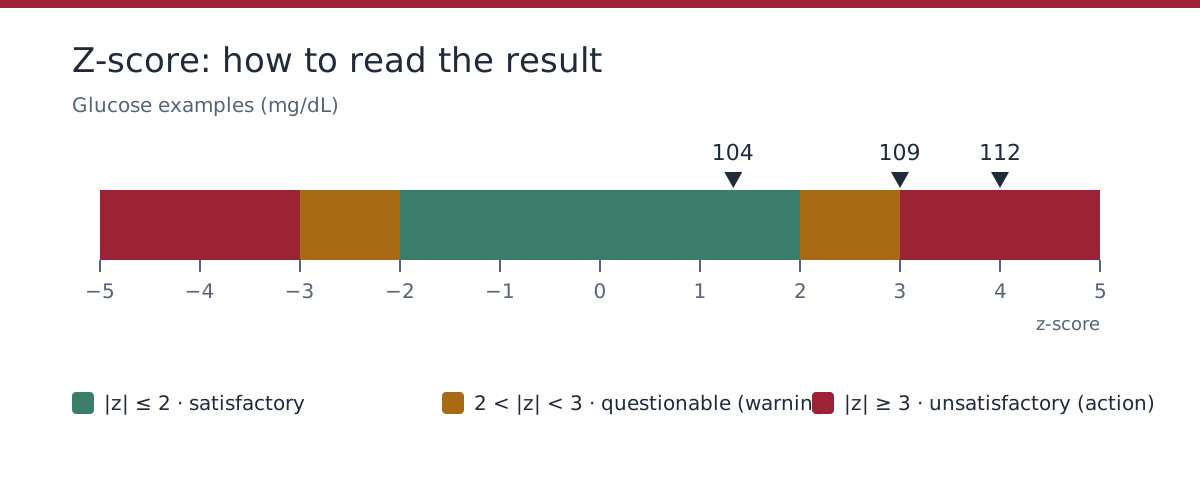
The second case shows why the laboratory must evaluate the result by its program's criterion and still watch how close it is to the limit. A result accepted by a small margin, repeated over consecutive rounds, deserves the same attention as an isolated failure.
Unacceptable result: how to investigate
An unacceptable result is the start of an investigation, not a number to correct. Repeating the sample until an acceptable value is obtained, or submitting a correction without an identified cause, does not meet the critical review required by the standards and hides the problem EQA should reveal.
Before looking for an analytical failure, rule out the simplest causes. Often the problem lies in transcription or in the comparison group enrollment.
| Category | What to check |
|---|---|
| Transcription and enrollment | Unit, decimal places, swapped samples or analytes, method and instrument declared to the provider. |
| Sample preparation | Reconstitution (volume, diluent and time), mixing, storage and stability until analysis. |
| Analytical process | Calibration, reagent lot, maintenance and the IQC of the day and the preceding weeks, including trends and warnings. |
| Material and evaluation | Matrix effect, a small or inappropriate comparison group, a questionable assigned value. If an evaluation error is suspected, use the appeal offered by the provider within the deadline. |
| Random error | A possible conclusion only after the other causes have been excluded. Record the reasoning and follow the next rounds. |
Next, assess whether the problem may have affected patient results from the same period. If IQC was stable and the cause was transcription, the impact tends to be none; if there was a systematic error in the analytical system, reviewing the reports already released must be considered. Record the conclusion, the corrective action, the person responsible and how effectiveness will be verified, usually by the analyte's performance in the following rounds.
To structure this record, see seven attitudes when facing a nonconformity and the guide to corrective actions and system stability.
Look beyond the round: trends over the cycle
A single round shows little. Over the program cycle, watch for:
- Results always on the same side of the assigned value, even within the limit, which suggests a bias to be confirmed in IQC.
- Deviations that grow in a specific concentration range.
- Analytes that perform worse after a lot change, calibration or maintenance.
- The percentage of acceptable results per analyte and per program over the year.
The mean relative deviation over several rounds is a useful estimate of bias and can feed the sigma metric, as long as it is compared with a total allowable error from a documented source.
When no proficiency testing exists
For tests not covered by programs, RDC 978/2025 requires alternative ways of assessing accuracy described in the scientific literature (Art. 189, sole paragraph), and PALC requires this assessment to be documented with limits, criteria and frequency (11.15). The most common alternatives are:
- Interlaboratory comparison with another laboratory that performs the same test, by exchanging samples.
- Analysis of reference materials or materials with a certified value.
- Comparison with another method, preferably a reference method, in the laboratory itself or at a partner laboratory.
- Clinical validation, such as correlation with the diagnosis or with the patient's other tests.
Repeat the availability check at least once a year: new programs appear and the laboratory's menu changes.
Indicators and records that support an audit
Simple indicators allow the technical manager to demonstrate the monitoring required by Art. 87 and help the laboratory notice changes before a failure.
- Participation: rounds submitted on time relative to the rounds planned in the cycle.
- Acceptable rate: acceptable results relative to evaluated results, per analyte and per program.
- Response time: days between the release of the report and the completion of the critical review.
- Recurrence: analytes with unacceptable results in more than one round.
- Effectiveness: corrective actions confirmed by performance in the following rounds.
Keep together, for each round, the receipt record, the raw analysis data, the check and the proof of submission, the provider's report, the critical review with its participants and the actions taken. These records must remain available for at least five years (Art. 115) and feed the annual performance report required by Art. 176, item V.
How to keep EQA organized throughout the year
With several programs, providers and deadlines at the same time, EQA tends to spread across emails, provider portals, spreadsheets and folders. What helps most is bringing together in one place the calendar and pending actions, the link between each program analyte and the IQC of the same instrument, the record of what was submitted and the history of evaluations and actions.
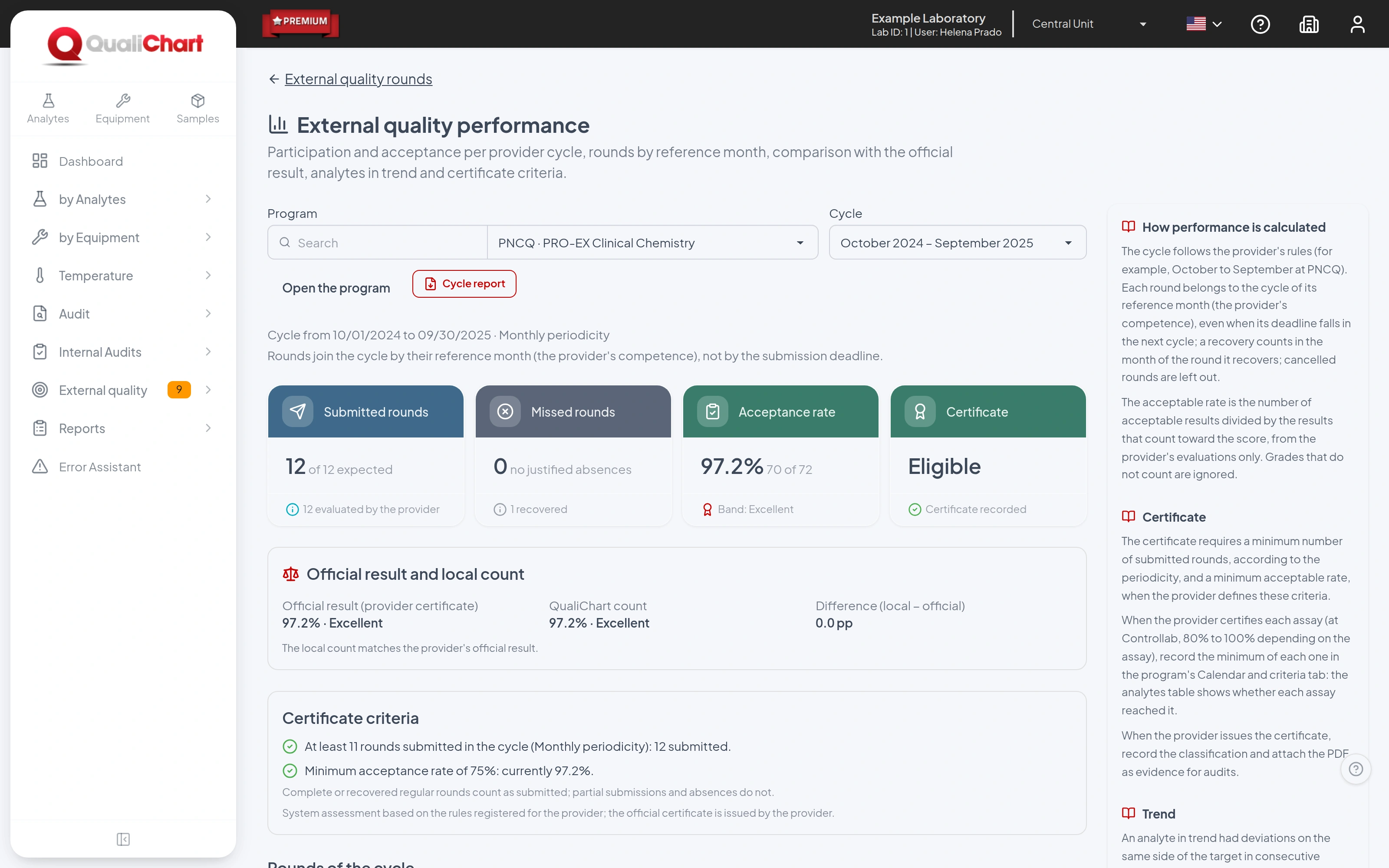
In QualiChart, the external quality module follows this sequence: rounds with the official calendar and deadline alerts, results linked to the IQC on the day of analysis, review and submission with a copy of each version sent, recording of the official grade with relative deviation, deviation index and z-score calculated as support, nonconformities with verification of effectiveness and cycle performance next to the provider's certificate.
Frequently asked questions
How often must the laboratory take part in EQA?
RDC 978/2025 does not set a number of rounds: it requires participation in programs covering all analytes and instruments in use and a performance report at least annually. The frequency of rounds is defined by each program, and PALC requires active and continuous participation.
Can I send the proficiency testing sample to a reference laboratory?
No. Art. 173 of RDC 978/2025 requires EQA to be performed at the service itself, and PALC prohibits using results obtained at reference laboratories, at other units or by consulting other laboratories.
Can a laboratory with two units have a single enrollment?
No. Participation must be individual for each service (Art. 186) and, under PALC, for each unit that performs tests (11.14).
Does an unacceptable result require reviewing patient reports?
Not automatically. The investigation must conclude whether the cause could have affected results released in the period. Transcription errors usually have no impact; systematic errors in the analytical system require evaluating the reports and recording the decision.
What should the laboratory do when it disagrees with the provider's evaluation?
First check the comparison group, the unit and the method enrollment. If the suspicion of an evaluation error persists, use the appeal offered by the provider within the deadline and record the outcome of the request.
How long must EQA records be kept?
For at least five years, according to Art. 115 of RDC 978/2025, including provider reports, critical reviews and actions taken.
References used
- Anvisa. Resolution RDC No. 978/2025, official text on Anvisalegis (in Portuguese)
- Anvisa. Questions and answers on RDC 978/2025 (in Portuguese)
- Anvisa. External quality control module (in Portuguese)
- SBPC/ML. PALC 2021 standard: Clinical Laboratory Accreditation Program (in Portuguese)
- SNA-DICQ. Accreditation manual for the quality management system of clinical laboratories, 8th edition (in Portuguese)
- ISO 15189:2022. Medical laboratories: requirements for quality and competence
- ISO/IEC 17043:2023. Conformity assessment: general requirements for the competence of proficiency testing providers.
- ISO 13528:2022. Statistical methods for use in proficiency testing by interlaboratory comparison.