
Critical supplies New
Critical supplies with traceability from the supplier to the IQC runs.
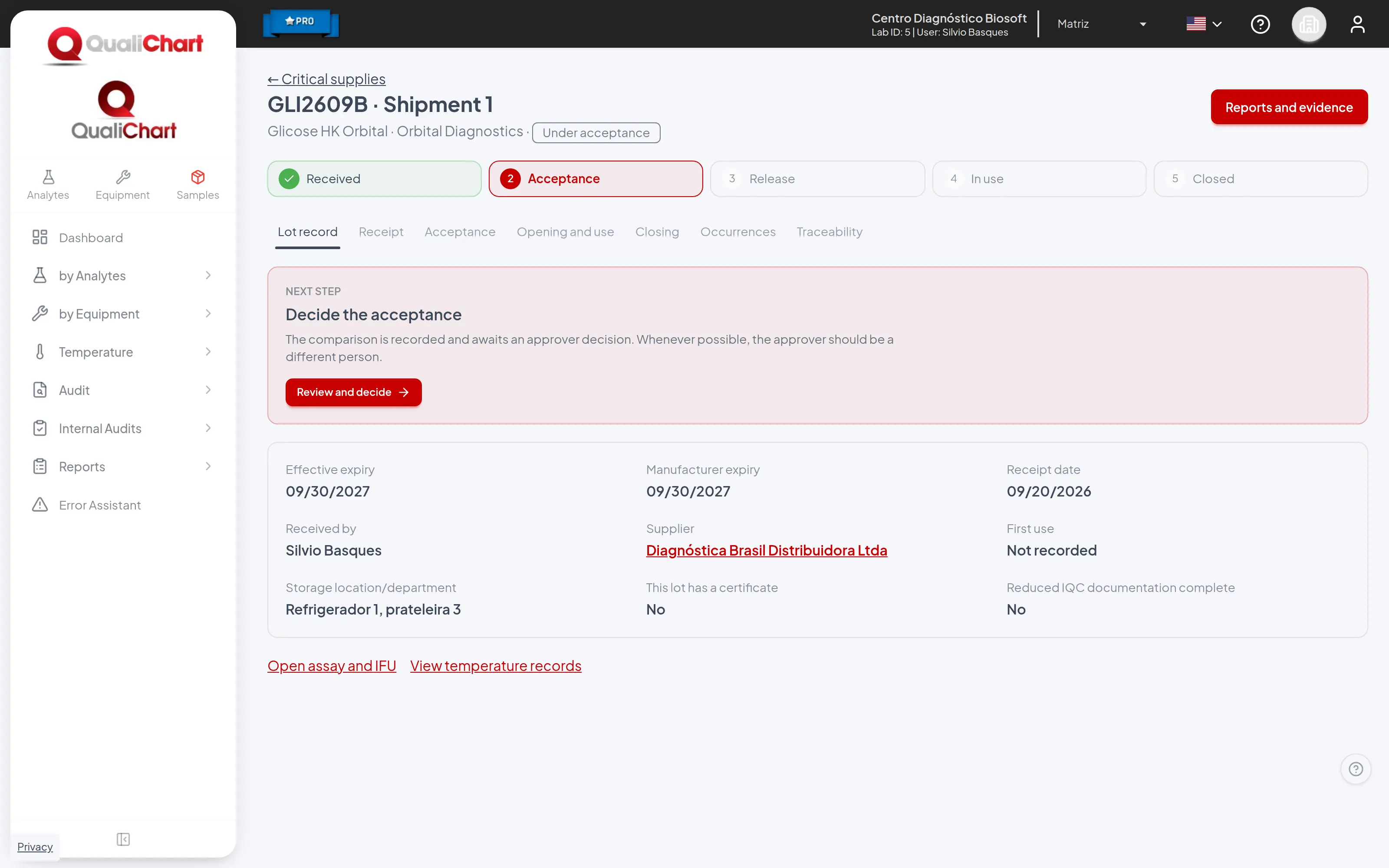
Reagents, calibrators and critical consumables follow their life cycle in the system: approved supplier, receipt, acceptance, use on controls and closure, always with the next step indicated.
- Qualified suppliers, with an approval expiry date
- Lot recorded automatically on every run
- Incidents, recalls and 13 reports
In the laboratory routine
The right lot, in the right control, with the right record
Brazil's RDC 978/2025 requires receipt to be recorded with the lot and transport conditions, and the technologies used to be traceable. When these data are kept outside IQC, linking a result to the lot in use means cross-checking records.
-
The challenge
Lot in use not recorded on the run
Knowing which reagent lot was in use on a given run depends on manual notes or on the team's memory.
In QualiChart
Once its use is declared, the lot is recorded automatically on every run of the control, whether entered on the control panel, by equipment, by file import or through the API.
-
The challenge
Lot changes without a criterion defined beforehand
Comparing lots without a criterion defined before measuring makes it harder to justify approval or rejection.
In QualiChart
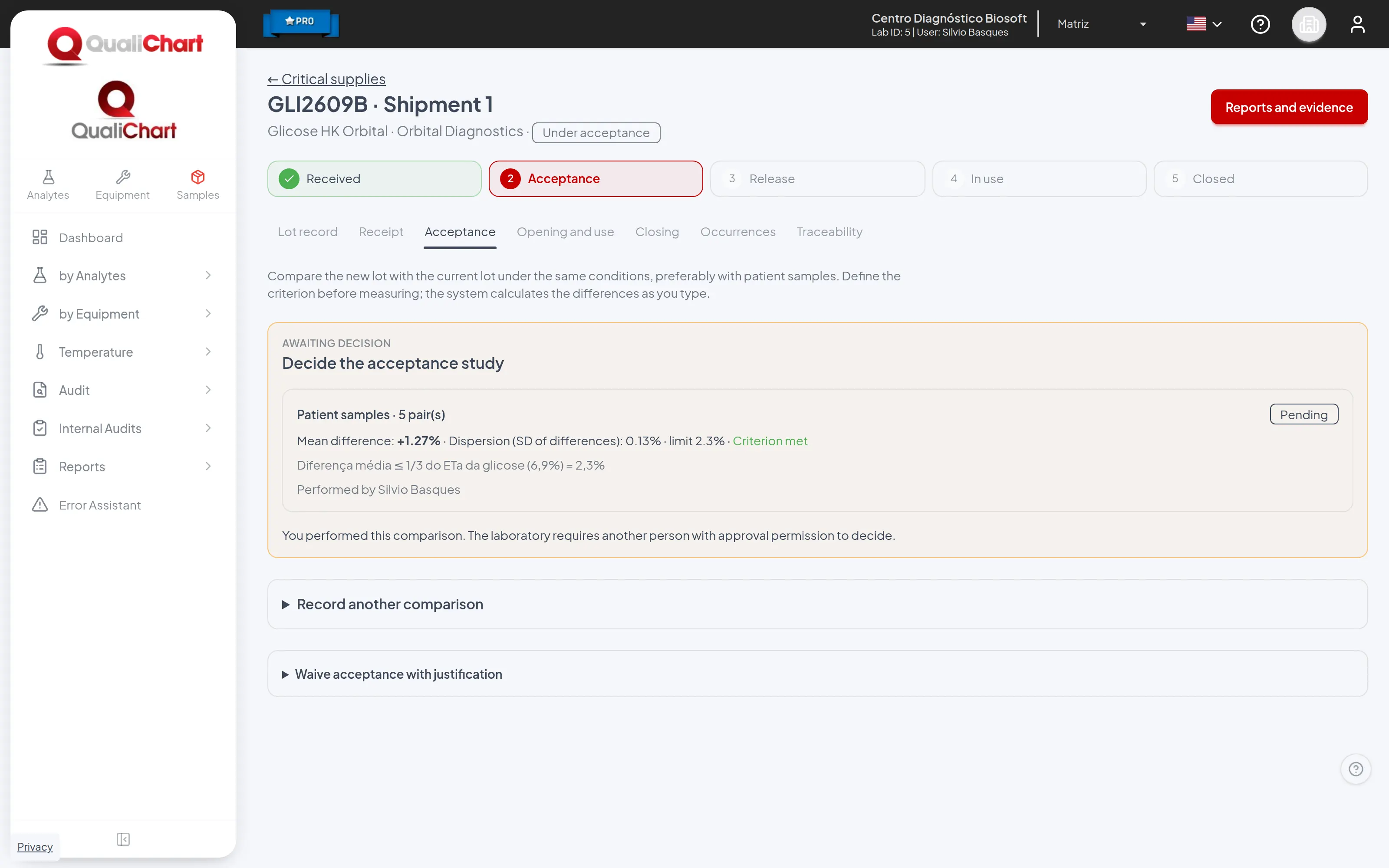
Acceptance records the samples, the criterion defined before measuring and the paired results. The decision requires a justification and can separate the person who performs it from the person who approves it.
-
The challenge
Incidents and recalls
When a lot is recalled or shows a problem, the laboratory needs to know quickly in which controls and runs it was used.
In QualiChart
Critical incidents and recalls block the lot, and the impact report shows the runs that used it.
How it works
The life cycle of a supply
Qualify the supplier
Evaluation by criterion, approval with an expiry date and periodic or extraordinary reassessments, without editing the previous ones.
Receive and check the lot
Product, lot, expiry date, packaging condition, transport and storage temperature. The GS1/UDI code can fill in the lot and expiry date.
Accept and declare its use
Lot-to-lot comparison when required, an opening checklist and the declaration of use in the controls that will receive it.
Monitor and close
Pending items, measuring range, the impact of lot changes on IQC, incidents and the closure of the lot.
Capabilities
Every lot, from receipt to the runs in which it was used.
Reagents, calibrators and critical consumables follow their life cycle in the system: approved supplier, receipt, acceptance, use on controls and closure, always with the next step indicated.
Optional: controls without registered supplies keep working as usual.
- Qualified suppliersEvaluation by criterion, approval with an expiry date and periodic reassessment.
- Lot receipt and acceptanceInspection on arrival and lot-to-lot comparison with a criterion defined before measuring.
- Lot recorded on every runOnce its use is declared, the lot is recorded automatically on the control's entries.
- Monitoring on the panelPending items, lots in use, measuring range and the impact of lot changes on IQC.
- Incidents and recallsCritical incidents and recalls block the lot, and the report shows the runs that used it.
- Supply reportsReceipt log, inventory and expiry dates, lot record, traceability and audit trail.
Requirements and good practice
What regulations require for supplies
- RDC 978/2025 · Art. 89
Technology management covers selection, acquisition, transport, receipt, storage, distribution, use, disposal and traceability.
Read the source - RDC 978/2025 · Art. 100
The receipt of in vitro diagnostic products, reagents and supplies must be recorded with data such as lot, transport conditions and date, to ensure traceability.
Read the source - RDC 978/2025 · Art. 102
Reagents and supplies must be used and stored as instructed by the manufacturer, without revalidation after the expiry date.
Read the source - ISO 15189:2022 · 6.6
Reagents and consumables require procedures for receipt, storage, acceptance testing, inventory management and records.
Read the source
The module is optional: controls without registered supplies keep working normally. The qualification and acceptance criteria are defined by the laboratory.
Do I need to register supplies to use IQC?
No. Its use is optional and works per control: when a lot is declared in use in a control, it starts being recorded on that control's runs.
Does the operator choose the lot when entering IQC results?
No. The lot declared in use is recorded automatically on every run. Suspended or recalled lots are blocked.
Which reports does the module issue?
Receipt log, inventory and expiry dates, lot record, labels, acceptance, traceability, impact, incidents, suppliers, compliance, critical analysis, imprecision and audit trail.
Does the system record the lot-by-lot certificate?
Yes, with the issuing laboratory, the expiry date and the training evidence. It supports the evaluation of the reduced frequency provided for in Art. 184 of RDC 978/2025, but it does not create a frequency policy on its own.
Further reading
Related content
Your next step in quality control
Put QualiChart to the test. Free for 30 days.
Create your account and evaluate QualiChart in your laboratory. Do you prefer a guided introduction? Request a demo with our team.