
Ensuring quality in clinical laboratory processes is the responsibility of all professionals in the field. Quality control must be part of the test routine, to ensure that the final result is as accurate as possible. To this end, it is essential to use and invest intelligent efforts in daily practice.
Clinical analysis laboratories have an essential role in society, detecting and indicating illnesses through examinations. A global estimate, made by ‘Labs are Vital™’, indicates that, on average, 70% of medical decisions are based on laboratory tests. This increases the responsibility of laboratories to deliver safe and correct results.
In this context, the "Internal Quality Control Journey (IQC)" emerges, a system made up of nine steps to ensure that analytical processes work correctly and that results are delivered safely.
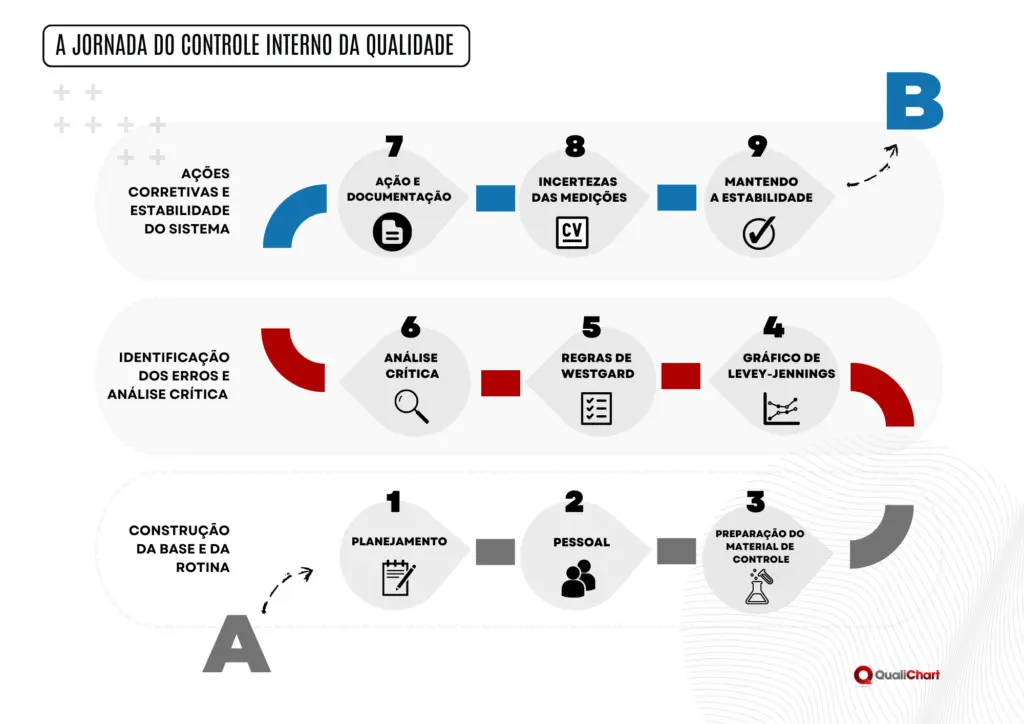
The IQC journey is an online guide that clearly and simply shows the steps necessary to face the challenges of internal quality control, such as validating control daily, performing critical analyzes correctly, applying multiple rules and managing the team and staff turnover.
If you want to know the steps, you can access our guide by clicking here and have access to all the information necessary to successfully follow the IQC journey.
With 18 thousand clinical analysis laboratories in Brazil, according to data from the National Health Surveillance Agency (Anvisa), the work carried out within each of them is directly related to the population's quality of life
The patient is put at risk when appropriate safety precautions are not taken during the examination processes, which range from pre-analytical phases, such as sample collection, through analytics and even post-analytical phases, as in medical interpretation. To this end, carrying out the quality control serves as a guarantee for the correct diagnosis and guidance on conduct.
"We rely on the information provided by laboratories to complement diagnoses and procedures for our customers. Having confidence in the results we receive helps to ensure the correct decision and benefit for the patient”. Complete Dr. Silvio de Almeida Basques.
Quality control supports the evaluation of the performance of analytical processes. Relate your procedures to current requirements, including RDC 978/2025 for the services covered, and to the technical specifications chosen for clinical use. See the current IQC requirements.
O clinical laboratory that incorporates concepts and scientific methods, raises your level of performance, increases your credibility and the participation of your collaborators. The realization of the Quality Control must be faced correctly and effectively. Therefore, doing it just for the sake of doing it or doing it incorrectly becomes a waste of time, as well as disrespectful towards patients.
With the control methods existing today, such as criteria, parameters and the computer program that performs statistical calculations and presents alerts, control has become practical and within everyone's reach. Therefore, carrying out this process enables quality and compensation in the recognition of clinicians, regulatory bodies and society.
How to do good control well
Many practices for Internal Quality Control (IQC) have been in common use for many years. Professionals who adopted them continue to use them, despite the fact that some have been shown to be inappropriate. This is because there is an inertia to make changes, to face possible barriers, or a lack of knowledge of new and good practices. The challenge that arises is how to implement a good control method and use it well, correctly and productively, that is, do good control well.
In contacts with professionals who registered to use the program QualiChart, we saw the different forms previously adopted for the IQC, some of which could be criticized:
1. There is no time to take care of IQC tasks.
Time is a challenge for everyone, in any activity. We never have enough time for everything, for necessary work, for rest, for family, etc. Therefore, we bring employees together and we must manage our time and theirs. To better manage time and obtain the results we want, we must use the strategy of delegating functions.
To make the most of your time you need to obtain team engagement. Learn to delegate, divide tasks and work with your team. Keep expectations for improvement high: people will strive.
You as a quality manager must take care of planning, acquisitions of inputs and systems, analytical techniques, costs, systems that have lost stability, corrective measures and much more. The implementation of some processes in your laboratory can be delegated to a technical, bench-level employee, who will carry out the operations. It will use the computer program for IQC, it will include the analytes (tests), will associate it with the equipment and associate it with control materials, always with your guidance. We have seen that this is a task in IQC that, when well delegated, is carried out with excellent results.
2. I already participate in the PNCQ and do not need to take IQC.
Internal control and external evaluation provide complementary information. Check which service was contracted and which activities remain under the responsibility of the laboratory. Participation in an external program does not replace the execution and analysis of internal control. See the current IQC requirements.
In fact, to obtain control of analytical imprecision external control is not useful. The practice of Internal Quality Control is necessary on a day-to-day basis. You can use the Pro-In® control materials in complete specialist software that will help you do good control.
3. I do IQC with Excel

electronic spreadsheets are good tools for calculations, statistics, etc. But they are generic. A specific spreadsheet for IQC, which makes it possible to perform good control, at up to three levels, with Westgard rules, with Levey-Jennings graphs for dozens of analytes, reports, error wizard and other supporting information is a challenge and I haven't found it yet.
Making an analogy, imagine that you want to see a beautiful picture hanging on a wall and you want to use the pliers tool to fix the nail. It may work, but it is not the best tool and its use can cause problems, such as a hurt finger and a bent, unstable nail. This is also how to do IQC with the Excel tool, a good quality pair of pliers, but still pliers. Through internet searches, it was not possible to find an Excel spreadsheet that does IQC well. The one we found for this purpose does not test Westgard's multiple rules, it does not justify the expense of materials, daily analysis of the material and the efforts to use it. It's not worth it and the practice doesn't last a month, a consequence of the confusion generated by the attempt to use it for all quantitative tests.
If you already spend resources on the control material and you have the job of carrying out the analysis, why not complete it with specialist calculation tools for IQC that will actually help you control your systems? Why not use the Westgard rules for better control results? If you adopt well-suited specialist programs (the right tool), you will be able to count on the participation of your bench assistants, to whom you will delegate functions in IQC, as per item 1, above. Your Internal Control will be much more effective.
The same reasoning also applies to those who perform the IQC, comparing the result with a range provided by the manufacturer. This is not good control. The range provided by the manufacturer should not be used for IQC limits, except for an initial period, which we call the preparation phase, according to Dr. Westgard. What can we say about the impossibility of using multiple rules, calculating the Coefficient of Variation and producing reports? If you already do the main thing, which is the analytical run of the material, you have already spent on it, complete with data analysis using the appropriate tool.
4. I make my graphics on the equipment itself
This is a subject that provokes several discussions, since there is a lot of equipment with different control software. We present some questions that represent the practice of good control and that we usually ask the professionals we speak to. Try to answer with YES, or NO:
- Does the equipment allow you to use the package insert data at one stage and then start using your own values for limits on the Levey-Jennings graph?
- Does the equipment software exclude runs out of control (outliers) from the series when calculating current values?
- Do you receive comparisons with CV values and maximum imprecision, to evaluate your own imprecision?
- Can you record occurrences and interventions in the system, relating to analytical runs?
- Do you have sequential assessments for systematic error detection (10x rule) for consecutive days?
- Can you specify different sets of rules for different analytes on the same instrument?
- Can you look at the analyte history and check previous outlier runs and what corrective measures were taken?
- If the laboratory has manual techniques for quantitative tests, can you handle IQC data from these tests in a practical and correct way?
- Can you issue IQC reports for long periods of time to demonstrate to the Health Surveillance?
- Can you access data from all your equipment (Biochemistry, Hematology, Hormones, Blood Gas Analysis, Immunology) from different locations, from your room, or even from another building, from another technical area?
If you answered NO to three or more of these questions, you will certainly benefit from adopting a specialist program for IQC. Or else, you won't be doing good control well.
Accreditation and Internal Quality Control
Quality can be quantifiable and investing intelligent efforts in this regard is inherent to good practices in Clinical Laboratories. It is essential to take care of the quality of results, bearing in mind that the magnitude and relevance of each professional's role in society makes efforts to achieve quality insignificant. This noble attitude is the way to make an honest and valuable contribution to the excellence of diagnoses and medical procedures.
The realization of Quality Control is important for the benefit of patients and so that professionals have more confidence in their results. Laboratory incorporates scientific concepts and methods, raises the level of its performance and makes it grow gives pride and satisfaction to its employees. Carrying out correct and adequate Internal Quality Control is mandatory to meet the requirements of accreditation programs, being an important step towards achieving recognition.
Another important motivation that laboratories have demonstrated is obtaining recognition, that is, becoming an accredited laboratory.
Accreditation is a process of external, periodic evaluation of the structure, processes and results of a company, organization or institution in relation to quality standards or requirements accepted in Brazil and other countries, which aims to continuously improve the quality of the services offered. It is important to highlight that external evaluation by Accreditation is a Voluntary, Confidential, Independent and Periodic process. (PALC Standard 2013)
The best way to achieve the goal of accreditation is to take care of the organizational development of your laboratory. Assessing broadly and methodically, identifying problems, adopting corrective actions represent the safe steps to obtain the best results.
DICQ Requirement for Internal Control
5.1.1 – THE CLINICAL LABORATORY MUST HAVE A QUALITY PROCEDURE DETERMINING THE GUIDELINES FOR AN INTERNAL QUALITY CONTROL PROGRAM COVERING ALL ANALYTES PERFORMED.
PALC Requirement for Internal Control – REQUIREMENTS FROM 11.1 TO 11.9
11.2 – THE INTERNAL QUALITY CONTROL PROGRAM (PCIQ) MUST COMPREHENSIVELY AND DETAILY INCLUDE THE INTERNAL QUALITY CONTROL SYSTEM FOR ALL QUALITATIVE AND QUANTITATIVE ANALYZES CARRIED OUT. THE PROGRAM MUST ENABLE THE INVESTIGATION OF ALL CAUSES OF VARIABILITY THAT MAY OCCUR IN EACH ANALYTICAL SYSTEM.
Essential items in Internal Quality Control:
Levey-Jennings Plot
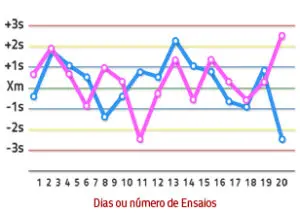
This is the most established method and used in clinical laboratories to practice control. It was adapted from the Shewhart chart, for controlling the production of materials. It is with the graph that tolerance limits for control are established, plotted according to the number of standard deviations, above and below the average. It plots serial results, obtained on the bench, from material analysis. Under conditions of stability of the analytical system, the distribution of points follows statistically predicted parameters, always oscillating around the target value, or average. It is called the normal, or Gaussian, distribution.
The analysis of the graph is very helpful in understanding the variability of the results obtained from the materials and can now point out the random errors or systematic. Even in the internal control preparation phase, when the mean and standard deviation values are still being defined, it is already possible to extract information on deviation, marked variability and trends, by analyzing the graph.
Westgard Multiple Rules
Uses a combination of criteria to check whether an analytical run is in or out of standard. The multiple rules provide greater sensitivity of the internal quality control system in detecting problems. Its use helps everyone to recognize the situation of changes in the performance of the analytical system, greatly reducing the natural complexity of this internal control operation.
As Westgard rules, for the internal quality control, are widely used in Brazil. They are didactic and useful for assist laboratory professionals in monitoring their control systems. They translate statistical probability and when violated indicate problems with the system, which must be analyzed. They can point out the type of error that occurs, if systematic error, or if random.
How do analytical systems have their own characteristics, a rule model that is more suitable for each system must be adopted. Knowledge of systems behavior is an important factor for specifying control strategies and choosing rules. Proper use of control rules improves the detection rate of errors, with lower false rejection rate.
For testing the multiple rules statistical calculations, records of the last ten runs and comparisons of values are required. This work was greatly facilitated by the use of computers, which would otherwise be impractical on a daily basis.
Calculation of Coefficient of Variation (CV)
It is essential to critically analyze the performance of the analytical system to identify opportunities for improvement in measurement quality to obtain lower values for the random error. This achieves imprecision, reducing the total error. The measure of imprecision can be given by the Coefficient of Variation (CV), calculated by the formula
CV = SD / Xm * 100. It is expressed as a percentage and provides a good estimate of the performance of the analytical method, in terms of variability.
The CV will be smaller, the smaller the variation in the control results, that is, the less imprecision there will be. Therefore, it is an interesting goal for the laboratory to achieve the use of a method that provides a reasonable CV, lower than the maximum desirable imprecision. The value for maximum imprecision for various analytes is another contemporary achievement and can be found in tables.
10 steps to implement Internal Quality Control
- Planning: Establish the foundations of the IQC, make a list of the analytes and which ones you want to control, the equipment in which they are controlled and other aspects of the analytical systems, such as instability and variability.
- Organize the materials: identify the supplier of the control material and have the set of analytes (tests or tests) in your line. Estimate your consumption and plan the purchase in volume for at least 6 months of the same batch.
- Obtain the materials: Contract with your supplier the control materials for the tests planned for 2 levels of control.
- Analyze the material package insert: Identify in the recommendations the level of control indicated for that batch. Level 1 for values in the reference range and 2 for pathological values.
- Use the control program: Access www.qualichart.com.br and sign up for the internal control program for free. Register the analytes you will control, enter the target for maximum imprecision and the rules you defined to test.
- Register equipment: Include the name of the equipment and associate the tests.
- Register materials: Enter the materials obtained for each level, associate the analytes with the material, informing Mean (Xm) and SD. Use the range of variation provided for the program to calculate the Standard Deviation (SD). Enter the level for control and enter the data.
- Perform the runs: Perform the tests on control samples, in the same way as you do for patients. The results must be collected to be used in the next phase
- Preparation phase: Choose the analyte and enter the run data for each level.
Observe the automatic drawing of the Levey-Jennings Chart for your visual analysis.
The first 20 runs are considered preparation phases, where the system will get to know its environment and determine the Xm and Dp values to be used in the next stage. - Enable control: Maintain daily data entry.
After 20 runs of the preparation phase, activate the controls to use your own Xm and SD values.
In this new phase, Westgard's Rules will be tested. If errors occur, you will receive alerts from the program.
Read the visual guide 10 steps to IMPLEMENT Internal Quality Control in the clinical laboratory.
Internal Quality Control – learn how to deal with errors
There are error situations in clinical laboratories that require permanent attention from professionals. Carrying out daily checks by Internal Quality Control and knowing how to adopt the best practices to address nonconformities is an important step to carrying out a good job, safely. Some professionals just repeat control runs when non-conformities are pointed out, which is not correct. The clinical laboratory must establish strategies to deal with these situations and incorporate them into daily life.
If quality control is well planned and the Quality Manager expands his knowledge test by test, his view of the analytical systems will be so consistent that it will enable clarity and greater accuracy in the search for solutions to problems that arise.
Knowing how to deal with loss of control and what actions should be taken is essential to guarantee test results.
We list 7 fundamental attitudes to deal with nonconformities in clinical laboratories:
- Inspect control chart in detail
- Analyze possible causes of errors
- Perform interventions in the system, aiming to correct the problem
- Note the measures taken to correct the problem
- Perform new analytical run, for control and patient samples
- Test the new data
- Interpret the result of the last assessment and decide on referral
To understand in detail, access our free eBook: 7 FUNDAMENTAL attitudes to deal with non-conformities.