
What is the total allowable error?
TEa is a specification for the total acceptable error in the measurement of an analyte, considering the purpose of the examination. It is a goal, not the error actually observed. It should also not be confused with an estimate of measurement uncertainty.
Where does the specification come from?
Performance specifications may consider clinical outcomes, biological variation, or technically available performance. The suitability of the model depends on the analyte and the use of the result. EFLM discusses these assessment models.
What to register when choosing
- Analyte, matrix, unit and concentration range.
- Specification source, edition or consultation date.
- Justification of suitability for clinical use.
- Quantity: absolute limit, percentage or combination of both.
- Responsible for approval and scheduled time for review.
A limit adopted by a proficiency testing program may have a specific purpose. Before using it as an internal goal, check the justification and application conditions. Don't select a specification just because it makes the method appear better.
How does TEa relate to IQC?
The laboratory can use the target in performance evaluation and control planning. The sigma formula compares the space between TEa and bias with the CV; therefore, changing the source of TEa changes the result even if the method remains the same.
Calculate the sigma metric and consult the imprecision table based on biological variation. Allowable imprecision and total allowable error are different specifications.
Supplementary Reference: Westgard: Method Performance Decision.
A table is a reference, not an automatic choice
Different fonts serve different purposes. Uma especificação derivada de variação biológica, um limite de ensaio de proficiência e um requisito baseado no impacto clínico não são intercambiáveis apenas porque aparecem em porcentagem. Record the purpose and version of the adopted font.
| Analyte | Criterion in relation to the target value | Attention when applying |
|---|---|---|
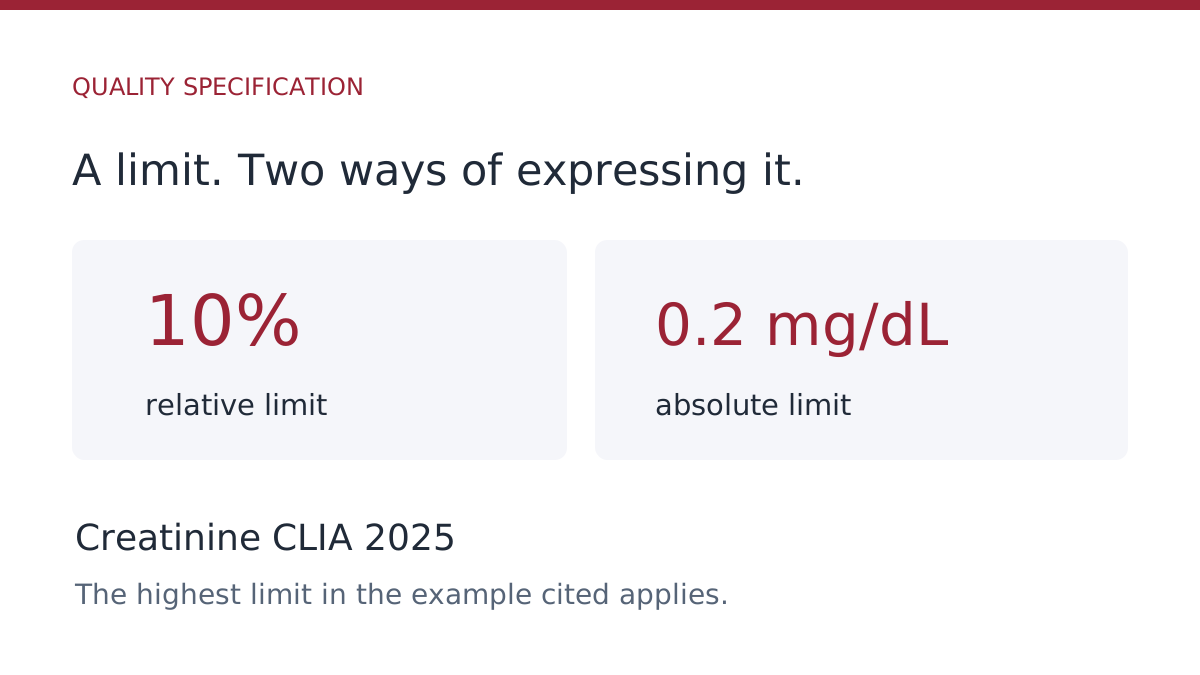
| Creatinine | ±10% or ±0.2 mg/dL, whichever is greater | Equivalent percentage limit depends on concentration |
| HDL-cholesterol | ±20% or ±6 mg/dL, the greater | Keep the unit indicated in the source |
| pCO₂ | ±8% or ±5 mmHg, the greater | Do not confuse partial pressure with concentration |
Source: 42 CFR §493.931, Official Publication of the United States. These criteria belong to the CLIA program; They are not mandatory limits imposed by Anvisa nor do they replace the technical selection of the specification for the laboratory's clinical use.
Convert mixed limits before calculating sigma
For creatinine with a hypothetical target value of 1.0 mg/dL, 10% represents 0.1 mg/dL. As the aforementioned criterion uses the highest limit, 0.2 mg/dL prevails, equivalent to 20% at this point. At 4.0 mg/dL, 10% represents 0.4 mg/dL, therefore the term percentage prevails. Using 10% in all concentrations ignores part of the criteria.
When using TEa in the sigma metric, check whether TEa, bias and CV refer to comparable concentrations. Do not mix mg/dL with percentage in the same equation. Keep the conversion account and the team's decision on the relevance of the reference.
The EFLM database provides another source of specifications, based on biological variation. To study the imprecision component, consult the imprecision table by analyte. The specifications need to be evaluated according to the characteristics of the method and the population of interest.