
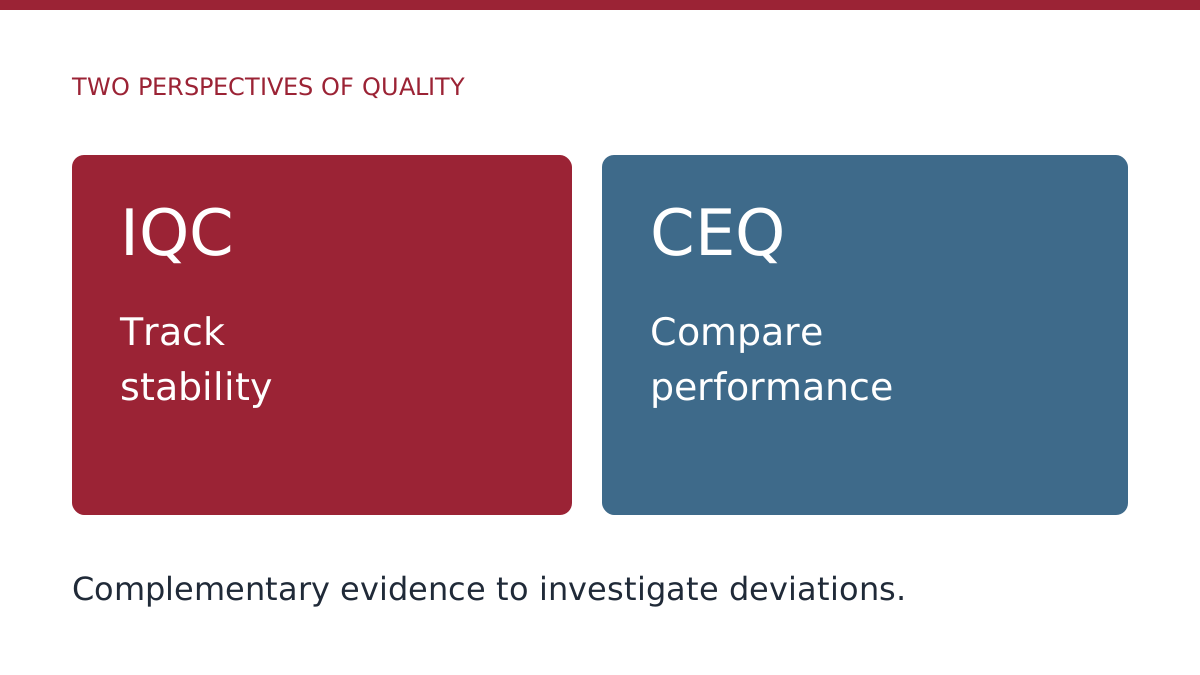
How do CEQ and IQC complement each other?
IQC monitors system behavior on a routine basis. External quality control evaluates performance through interlaboratory comparisons conducted by a proficiency testing provider. One process does not eliminate the need for the other.
Treat the result as a starting point
When receiving the report from the provider, check the method, unit, comparison group and criteria used. An unexpected result requires investigation; repeating a measurement without identifying the cause does not end the critical analysis.
Organize the investigation
- Check sample identification, preparation and conservation.
- Review transcript, units, and shipping setup.
- Examine calibration, reagents, maintenance, and period IQC data.
- Record hypotheses, conclusion, action taken and verification of effectiveness.
For tests not included in available programs, evaluate the alternative forms permitted in the regulations and document the justification. The solution must be suitable for the test and the service.
Gather the evidence
Keep reports, team assessment and action history accessible. Analyzing trends between rounds can help identify persistent problems while respecting differences between materials and comparison groups.
References: Anvisa: external quality control module and questions and answers about RDC 978/2025. Complete the quality self-assessment script.
From provider report to documented action
When receiving an evaluation, confirm that the comparison group corresponds to the method used, that the unit is correct and that there was an error in transcription. Then, examine the result in light of the program's criteria. Inadequate performance should not be reduced to changing a number on the spreadsheet: it is necessary to investigate the process that produced the result.
Consider a didactic scenario in which internal control remains stable, but the proficiency test shows persistent deviation from the assigned group or value. Internal stability can coexist with systematic displacement. Record the analysis of the traceability, calibration and comparability of the material before deciding on an intervention.
In the reverse scenario, a suitable result in the outer round does not make it acceptable to ignore a violated rule in routine control. The two instruments observe different sections of performance.
Prepare an analysis that remains useful in the next round
- Identify round, analyte, level, equipment, and material.
- Record the submitted result, assigned value and evaluation criteria.
- Check for pertinent pre-analytical, analytical and transcriptional errors.
- Relate the investigation to graphs and events from the same period.
- Define responsible, action and way to verify effectiveness.
- Compare subsequent rounds and record the conclusion.
In critical analysis, differentiate the observed evidence from a causal hypothesis. The documentation must allow you to know why the team accepted or rejected each hypothesis. PLUS scientific support may form part of the contracted monitoring scope.