
Qualitative and semi-quantitative New
IQC for serology, reagent strips and results on a scale.
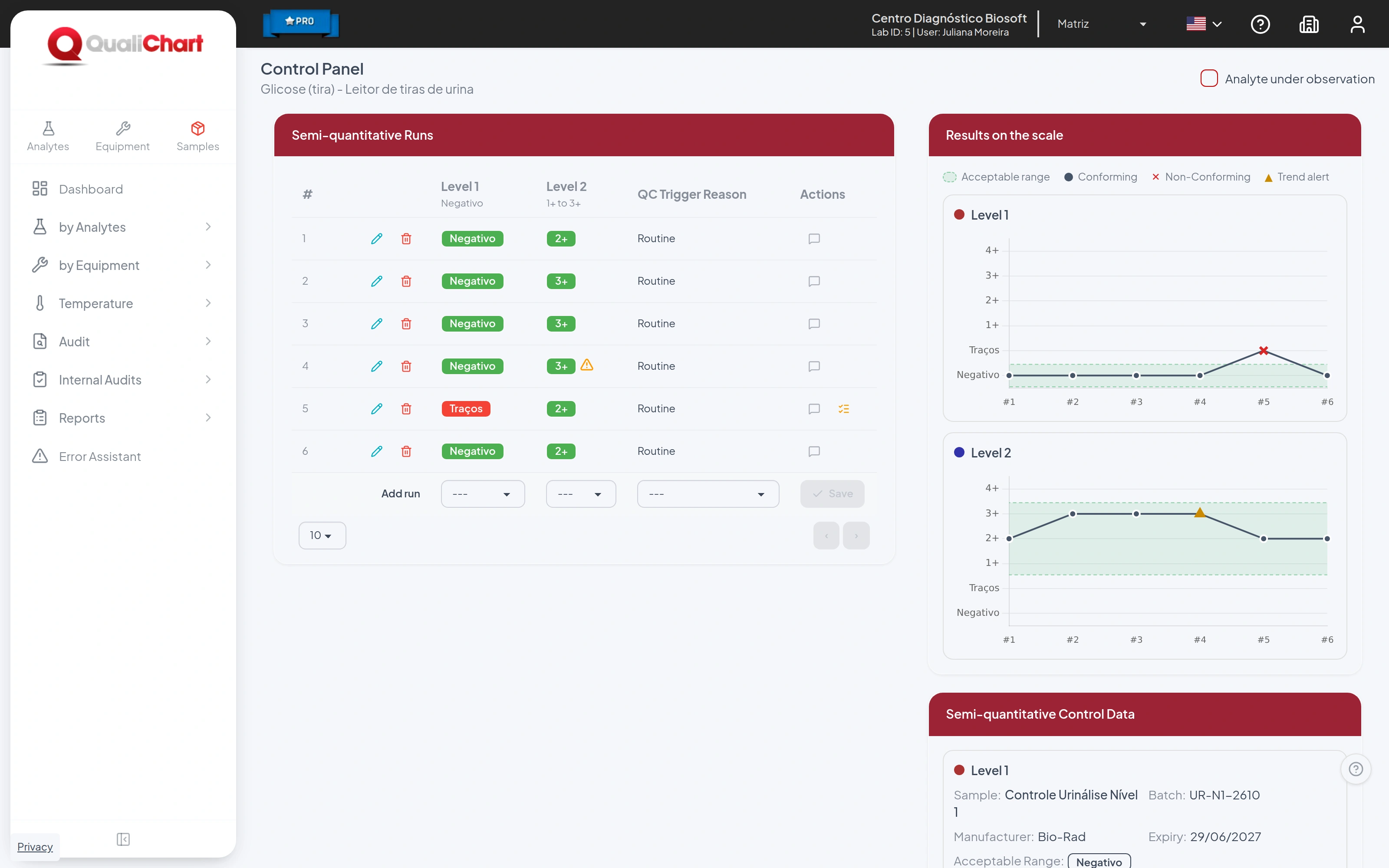
Qualitative analytes are evaluated against the material's expected result. Semi-quantitative analytes, against an acceptable range on an ordered scale, with a trend warning before the result leaves it.
- Conforming or nonconforming before saving
- Acceptable range per level, such as 1+ to 3+
- Chart on the scale and trend warning
In the laboratory routine
Results without numbers also need criteria and records
Brazil's RDC 978/2025 requires IQC for all analytes performed. In rapid tests, serology and reagent strips, control is often kept in logbooks or spreadsheets, with criteria that are less explicit than in quantitative IQC.
-
The challenge
A different criterion for each material
Each control has an expected result or an acceptable range defined by the manufacturer. Checking the right criterion at the time of entry depends on consulting the package insert.
In QualiChart
The expected result or the range of each level is stored with the material and shown on the control panel. The result is marked as compliant or noncompliant before it is saved.
-
The challenge
Gradual shifts on the scale
In reagent strips, results that repeat at the edge of the range may indicate a drift before any nonconformity occurs.
In QualiChart
A trend warning points out consecutive runs at the same edge of the range, according to the sequence configured for the analyte. The warning does not fail the run.
-
The challenge
History that is hard to compare
Without a chart, seeing how a level behaves over the weeks means rereading the records one by one.
In QualiChart
The Results on the scale chart shows each level with the shaded range and highlights noncompliant results and warnings.
How it works
From setting up the scale to handling the nonconformity
Define the type and the options
Qualitative, with the result options, such as Reactive and Nonreactive; semi-quantitative, with the ordered scale, such as Negative, Trace and 1+ to 4+.
Link the criterion to the material
Expected result for qualitative analytes; acceptable range for each level for semi-quantitative analytes, as stated in the package insert.
Enter on the control panel or by equipment
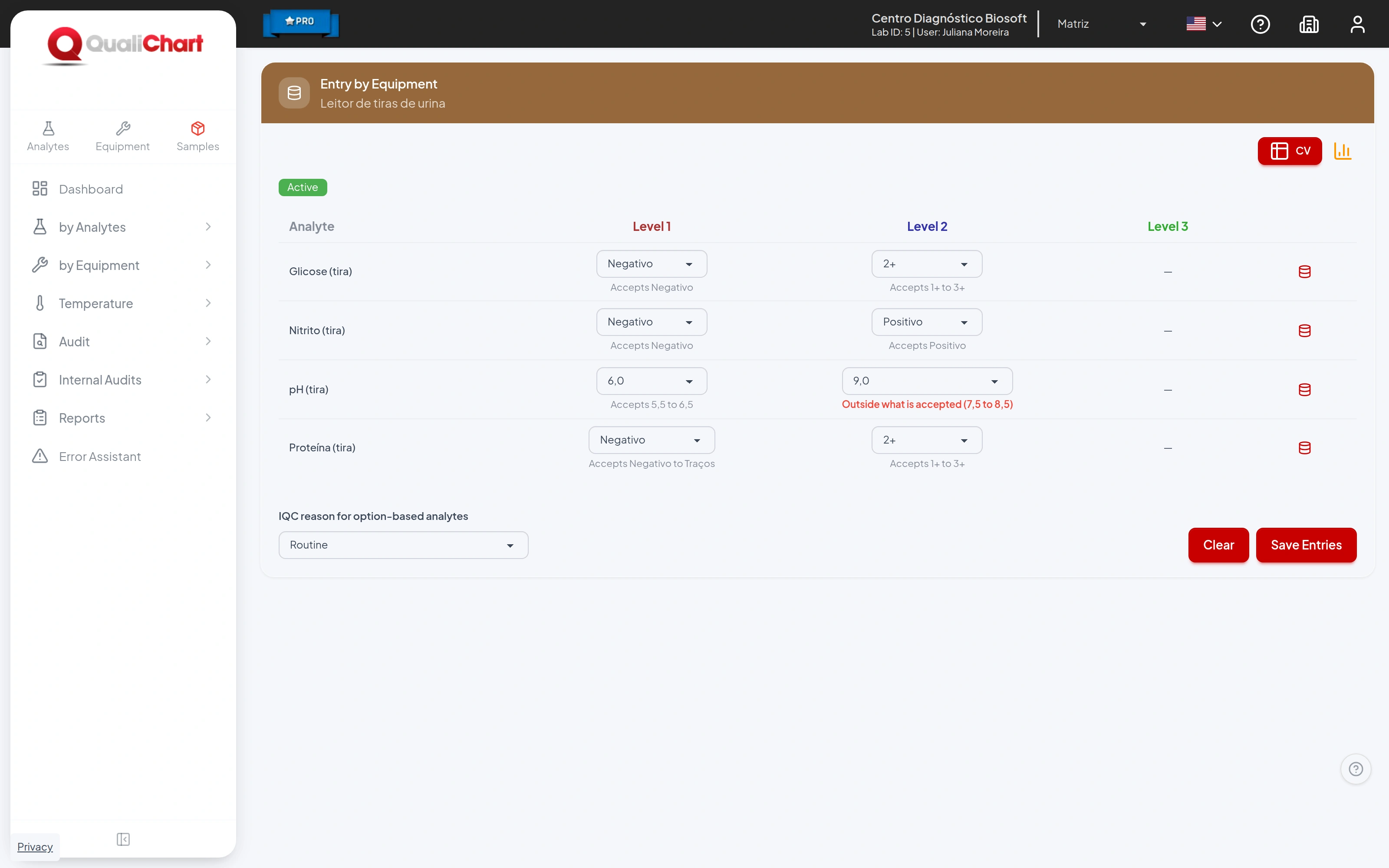
Select the result and the IQC reason: routine, lot change, new shipment, maintenance or other. For a urine strip, the analytes are entered together.
Handle the nonconformity
Record the root cause and the corrective action. The causes written down become available in the laboratory's next analyses.
Capabilities
Also for results that are not numbers.
Qualitative analytes are evaluated against the expected result. Semi-quantitative analytes, against an acceptable range on an ordered scale, such as Negative, Trace and 1+ to 4+.
- Conforming or nonconforming at onceEach result is evaluated before it is saved, against the expected result or the material's range.
- Ordered scale per analyteNegative, Trace and 1+ to 4+, pH values or another scale, with the acceptable range for each level.
- Trend alertA warning when consecutive runs fall on the same limit of the range, before a result leaves it.
- Results on the scaleA chart per level with the shaded range and nonconforming results and alerts highlighted.
- Entry by stripGlucose, protein, pH and nitrite from the same strip entered together in Entry by Equipment.
- Critical analysis with a written causeRecorded causes become available for the laboratory's next analyses.
Requirements and good practice
What regulations require
- RDC 978/2025 · Art. 180
IQC must cover all analytes performed, with acceptance and rejection criteria by type of analyte and according to the methodology, and the recording of inadequacies, causes and actions.
Read the source - RDC 978/2025 · Art. 183
For tests using single-use in vitro diagnostic products, IQC must be performed at least at every lot change, at every shipment and according to the manufacturer's instructions.
Read the source - RDC 978/2025 · Art. 182
The control sample must be analyzed in the same way as the patient sample.
Read the source
The IQC reason recorded on each run helps demonstrate the frequency actually practiced. Defining the frequency and the criteria remains the laboratory's responsibility.
Besides numbers, which results does QualiChart accept?
Qualitative results, evaluated against the expected result, such as Reactive and Nonreactive, and semi-quantitative results, evaluated against a range on an ordered scale, such as Negative, Trace and 1+ to 4+, or pH values.
Do qualitative analytes use Westgard rules?
No. They have no unit and no Westgard rules: compliance is evaluated against the material's expected result.
Can I import these results from a file?
No. Qualitative and semi-quantitative analytes are entered on the control panel or through the entry by equipment; file import rejects these rows.
What happens if the material's range changes?
Runs already entered keep the criterion they were evaluated with. A correction is evaluated against the criterion stored on the run, and the original result remains on record.
Further reading
Related content
Your next step in quality control
Put QualiChart to the test. Free for 30 days.
Create your account and evaluate QualiChart in your laboratory. Do you prefer a guided introduction? Request a demo with our team.