RDC 978/2025, of June 6, 2025, establishes requirements for services that perform Clinical Analysis Exams (EAC). It replaced RDC 786/2023 and must be consulted with its amendments, including RDC 986/2025. This article organizes quality control requirements to support routine laboratory review.
1. Relate IQC to the quality assurance program
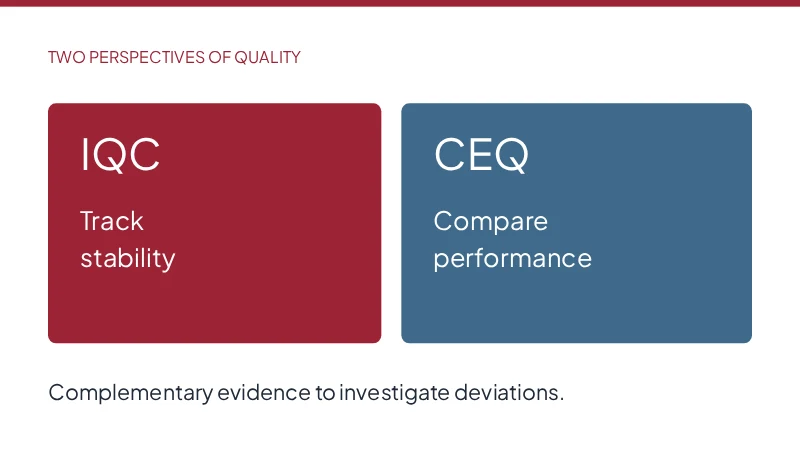
Internal control is not limited to approving an isolated result. Quality control management integrates the quality assurance program and brings together IQC and external control (CEQ). The laboratory needs to maintain written instructions, criteria and records that allow routine decisions to be understood.
Arts. 177 to 180 deal with participation in IQC, individual by service, covering the equipment in use and the analytes performed. When reviewing the process, check the relationship between equipment, method, analyte, control material and evaluation criteria.
2. Define criteria before evaluating results
Art. 180 organizes five IQC points:
- Monitor the analytical phase with analysis of the control sample, recording of results and evaluation of data.
- Define acceptance and rejection criteria by analyte and methodology.
- Release or reject analyzes after evaluating control results.
- Record inadequacies, investigation of causes and actions taken for rejected controls.
- Establish how control results will be evaluated.
In practice, document what leads to a rejection and who assesses the problem. Simply repeating the control until an acceptable value is obtained does not replace investigating the cause. See the steps to deal with nonconformities.
3. Check the control material and sample treatment
Arts. 181 and 182 deal with control samples and alternatives when there is no commercial material or material provided by a provider. In these situations, alternative ways of assessing precision need to be described in the scientific literature. The control sample must be analyzed in the same way as the patient sample.
Before changing the routine, check the consolidated text, the scope of the method and the applicable instructions. A range reported by the manufacturer needs to be evaluated in the context of the method; it does not eliminate IQC planning.
4. Plan frequency according to product type
Art. 183 distinguishes single-use in vitro diagnostic products from others. For single-use products, the minimum includes each batch change, each shipment and the manufacturer's instructions. When measuring equipment is available, preventive and corrective maintenance are also considered. For other products, the rule includes, at a minimum, each analytical run, the manufacturer's instructions and maintenance.
Art. 184 does not grant an automatic exemption. Reducing the frequency of each batch change depends on technical criteria and the joint fulfillment of the expected conditions: preservation of IQC objective, initial training with evidence and certificates from batch-to-batch certification programs conducted by accredited laboratories. The certificate must remain available to the health authority.
5. Keep the investigation traceable
Organize results, criteria, decisions, investigated causes and corrective actions so that they can be recovered. Relate records to relevant changes, such as calibration, reagent lot, and maintenance. Documentation needs to reflect what was accomplished, with responsibility defined by the team.
Use IQC educational diagnosis to discuss routine points. The result helps organize the conversation and is not equivalent to an inspection or certification of compliance.
How QualiChart supports this process
The system brings together Levey-Jennings graphs, Westgard rule evaluation and records of critical analysis and corrective actions. The standard does not require the hiring of specific software. The choice of tool must consider the ability to apply the criteria and preserve laboratory evidence.
Sources and next reading
Reference: RDC 978/2025 consolidated with RDC 986/2025, especially arts. 171 to 184. See Anvisa's official guidelines and the questions and answers document. For an overview of the complete regulation, read RDC 978/2025: organization of laboratory requirements.
Labeling and traceability of materials
Include the identification and conditions of use of reagents and materials in the review of procedures. The control record must make it possible to relate the occurrence to the material and batch used, without losing the manufacturer's information. Check the relevant requirements in the consolidated text of the standard and in the procedures approved by the technician responsible.
Biosafety integrates the service organization
Analytical control is part of a larger set of processes. Biosafety procedures, training, waste management and incident response must accompany the activities performed. An IQC tool does not replace these procedures or the evaluation of their execution in the laboratory.
See RDC 978/2025 on the official AnvisaLegis database and the questions and answers about its application.
Accreditation and licensing
Health requirements and laboratory accreditation programs have their own purposes and processes. The adoption of IQC software does not certify the laboratory nor does it replace the evaluation of those responsible, the health body or the accreditation program.