

1- Professionalism
Carrying out internal quality control may seem, to many, like work or an unnecessary waste of time. Some believe that taking care of control can be a simple, partial thing, with half measures and half controls. They think they can do something simpler and that will meet their needs.
These are those that carry out the control only by comparing the result with the minimum and maximum range of the material package insert. They don't even have the Coefficient of Variation calculation. Or those who do it with Excel spreadsheets, which although it is good software, is not suitable for the control function in clinical laboratories.
The QualiChart argues that the Quality Control is a serious matter and must be approached correctly and effectively. Doing it just for the sake of doing it is a waste of time. Doing it incorrectly is a waste of time and money and means disrespect towards the customer.
There are items that we consider the most significant, to establish the rational bases because the professional in the area of clinical laboratory must engage intensely in activities for the quality of the fruits of their labor. They are:
- Professionalism;
- Favorable technological advancements;
- Laboratory management;
- Ethics;
- Laboratory accreditation;
- Legal compliance.
Anyone who works in clinical laboratories is a very differentiated professional and is a provider of information. His training made him so, capable of providing this service to the community, doctors and patients. Its main role is to use specialized information of the best scientific standard, serve the customer and obtain appropriate samples, analyze biological materials with good methodologies, and deliver quality information. To do this, you use a lot of specific information, specific to your work context, which is the laboratory test. In the health segment, the challenge is great for professionals, who need to make an effort to improve the reception and search for contextualized information, to build knowledge.
We understand that the laboratory professional is an information provider, represented by test report performing. It builds information from raw data, obtained from analysis methodologies that it takes care to keep stable and with recognized performance. The good development of these processes involved guarantees the quality of your results and work.
Let's address the sequence of meaning of the terms that help to understand the information and how the higher-level professional fits into what we call the DICE equation. In it we try to show who is able to best interpret and judge the information.
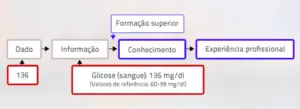
Data:It is the primary element in the knowledge formation process and is usually a number. It lacks an explanatory framework and does not enable decision-making. It is the basic input of computers and statistical tools. In isolation it may be meaningless, but the quality of this data will determine the value of the information it can comprise. In the clinical laboratory, the data may be the result of an analysis. Example: 136
Informationçare:Information is the great ocean accumulated by humanity throughout its existence, available in voluminous form via the internet and accessible to everyone who is at least literate in technology. It is possible to obtain information from different sources very easily, which can be beneficial or harmful.
Yes, because this requires characterization of the quality of the source, in addition to judgment criteria on the part of those who will use the information. This task is complex, but it can be done well by those who have the training for it, that is, a higher-level professional in the respective area of knowledge.
With the internet, featuring high availability, dissemination and freedom of access, all patients have access to Health Information (ISS), but, by concept, they will not know what to do with most of it, or they may get confused. There are many studies on the use of ISS by patients, sometimes confronting professionals in their conduct. Dealing with information appropriately, respecting personal limits is a challenge for everyone and is a reality that must also be focused on from the positive side: a well-informed patient can be an ally in the care of their health and that of their family members.
The function of the clinical laboratory is to deliver information and does so in the form of test reports. This information is of great importance and can often be decisive for the individual who provided their biological sample, at the request of another professional.
Result interpretation
Example: Glucose (blood): 136 mg/dl (Reference values: 60 – 99 mg/dl)
Please note that the data previously presented is now part of the information, it has gained context in this report, in such a way that it allows interpretation and decision making. However, it is important to note that this must be done by someone who is trained to do so. Different people will read this information differently, see below: Professional laboratory
- The laboratory professional will consider that the result represents an abnormality for the patient, because he knows that the sample was collected under defined fasting conditions, was processed appropriately, analyzed in a stable system and under internal control and that until the end, in the printed result, there was no error. He must be able to employ all his knowledge and ensure, through his Quality Management System, that the result is as close to the patient's reality, considering the variability inherent to analytical systems. This is what patients and attending physicians expect from him. Professionalism is defined there as a guarantor of the quality of this information, but the application for the patient will be the responsibility of another professional.
- The patient who receives this report will immediately classify their result as altered, based on the information provided by the laboratory, which says that for that method the reference range is 60-99 mgdl. In conversations with people you will conclude that “you are diabetic”. It is worth mentioning the important and frequent observation that is prudently added to most laboratory results: “Only your doctor is able to evaluate this result adequately”. This caveat is very appropriate. When drawing their own conclusions, the patient will make a lot of mistakes.
- The requesting physician will evaluate the result and, based on his knowledge of the patient's symptoms and signs, the criteria of the World Health Organization (WHO) and the criteria established by committees and obtained in other contexts, will treat this information with professional care. You must request a new test, every 10 days and, if the result is also higher than 126mg/dl, you must confirm the diagnosis of diabetes. From there, you will expand the diagnosis, gathering more knowledge and, above all, based on your “Professional Experience”, to establish propaedeutic, therapeutic and educational procedures.
We can see that there are two professionals involved in evaluating the report, in addition to the patient, who is in an intermediate and somewhat passive position, naturally. It is up to him to trust the two professionals he turned to: one, who has the knowledge, experience and methodologies to obtain the best measurement of that magnitude in the appropriate biological material and ensure that the result is the best expression of the patient's reality; the other, who has the knowledge to better bring together clinical and laboratory information, integrating it into the diagnostic or monitoring context.
The best attitude in laboratory professional obliges you to ensure the quality of the information you deliver and thus contribute to the excellence of doctor's practice. For the doctor, the best attitude is to carefully apply information and make decisions for the patient benefit.
2- Favorable Technological Advancements

Information technology has led to the creation of an internal quality control program, such as Qualichart, which helps healthcare professionals maintain the services provided by laboratories with efficiency, quality and speed.
Laboratory professionals, among those who work in the health sector, are privileged to be able to count on validated measurement methods, supported by statistics and computers, with the aim of identifying possible losses of stability that could compromise the quality of their results. Incorporating technology into your work is a facilitating element. It must be adopted.
Even before the creation of an internal quality control program, applicable statistical methodologies were already available to clinical laboratory professionals to assist in the practice of internal control. They are: the Levey-Jennings graph, the Multiple Control Rules (Westgard Rules) and the calculation of the Coefficient of Variation, as a measure of analytical variability. However, the tool that did the “heavy lifting”, that is, the statistical calculations, was missing. This solution was brought by Information Technology. Without it, the practice of internal control, daily as it should be, would not be possible. Computers have made a huge difference in Statistical Quality Control.
Levey-Jennings Plot
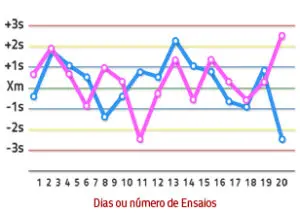
This is the most established method used in clinical laboratories to practice control. It was adapted from the Shewhart chart, for controlling the production of materials. It is with the graph that tolerance limits for control are established, plotted according to the number of standard deviations, above and below the average. It plots serial results, obtained on the bench, from material analysis. Under conditions of stability of the analytical system, the distribution of points follows statistically predicted parameters, always oscillating around the target value, or average. It is called the normal, or Gaussian distribution.
The analysis of the graph is very helpful in understanding the variability of the results obtained from the materials and can now point out the random errors or systematic. Even in the internal control preparation phase, when the mean and standard deviation values are still being defined, it is already possible to extract information on deviation, marked variability and trends, by analyzing the graph.
Westgard Multiple Rules
Uses a combination of criteria to check whether a analytical run is in or out of standard. The multiple rules provide greater system sensitivity internal quality control in troubleshooting. Its use helps everyone to recognize the situation of changes in the performance of the analytical system, greatly reducing the natural complexity of this internal control operation.

The Westgard rules, for internal quality control, are widely used in Brazil. They are educational and useful to assist laboratory professionals in monitoring their control systems. They translate statistical probability and when violated indicate problems with the system, which must be analyzed. They can point out the type of error that occurs, whether it is a systematic error or whether it is random.
How do analytical systems have their own characteristics, a rule model that is more suitable for each system must be adopted. Knowledge of systems behavior is an important factor for specifying control strategies and choosing rules. Proper use of control rules improves the detection rate of errors, with lower false rejection rate.
To test the multiple rules statistical calculations, records of the last ten runs and comparisons of values are necessary. This work was greatly facilitated by the use of computers, which would otherwise be impractical on a daily basis.
Calculation of Coefficient of Variation (CV)
It is essential to critically analyze the performance of the analytical system to identify opportunities for improvement in measurement quality to obtain lower values for the random error. This achieves imprecision, reducing the total error. The measure of imprecision can be given by the Coefficient of Variation (CV), calculated by the formula
CV = SD / Xm * 100. It is expressed as a percentage and provides a good estimate of the performance of the analytical method, in terms of variability.
The CV will be smaller, the smaller the variation in the control results, that is, the less imprecision there will be. Therefore, it is an interesting goal for the laboratory to achieve the use of a method that provides a reasonable CV, lower than the maximum desirable imprecision. The value for maximum imprecision for various analytes is another contemporary achievement and can be found in tables.
3- Laboratory Management
To ensure better laboratory management it is necessary to have in-depth knowledge of techniques and tools that help maintain a quality service and adequate equipment for employees.
The practice of internal control, as it is everyday e comprehensive, allows for in-depth knowledge of analytical technique and verification of better or worse performance of equipment, reagents, calibrators e operators. It is possible to detect quantitatively, that is, through numerical indicators, the performance of a system, calibration needs, maintenance needs and even detect the moment to replace the system with another with better technology and stability. All of this backed by numbers that will support your arguments in discussions with your superiors, expense managers and potential suppliers.
Fault management
Quality Control is like security. You should conduct it regularly to make sure there are no failures, no problems, even if the history of an analyte is reassuring. But, unfortunately, failures can occur. Managing failures means detecting them, being able to identify the root cause and acting to minimize damage to patients and your staff. Once the causes are found, efforts should be made to implement a preventive process that prevents new occurrences and then monitor the implementation of this process. Monitoring in the analytical fase uses the Internal Quality Control method. The biggest exercise will be for failures in the pre-analytical phases and post-analytical, where there is no statistical process control and quality cannot, in most cases, be be quantified.
The standardization of processes in the stages of laboratory tests is a form of ensure a quality no laboratory, the fault management and good general management. Many clinical laboratories use the Standard Operating Procedures (POP) as a way of guiding processes to be carried out as planned and thus minimizing errors and ensuring quality. The use of POP is an established practice.
Supplier
The market often brings new innovations and the professional is convinced by sellers to adopt another line of reagents at a lower price, replacing a previous one that was stable. The introduction of new methodologies is one of the most critical actions in the laboratory and can threaten the stability of systems and the quality of results. O internal quality control can help you identify the advantages and disadvantages of this replacement by highlighting objective evidence about what is fundamental: the quality of your results.
Similarly, control materials which, if they do not have the best standard and are not made available on a regular and continuous basis, can compromise the results of the work in internal quality control. Ideally, clinical laboratories should seek to obtain the appropriate control material for the analytical system, have a consumption forecast and a delivery plan for this material from the supplier.
Suppliers are constantly evolving in the production and availability of materials that can meet the growing control needs of laboratories. Good interaction with your supplier will help the laboratory manager to make the best choice.
Personnel Training

It is necessary for clinical laboratories to provide training and training for employees who deal directly with processes, especially the most critical ones, adopting regular training programs. It is also important that clinical laboratory professionals understand quality management, which is the planning, implementation and monitoring of quality, administrative and technical systems.
Manage analytical systems is an assignment of laboratory professional and he should seek to do so to the maximum extent possible supported by data and information. O internal quality control, by providing performance indicators, is an important ally for management regarding maintenance, or replacement of a analytical system, in part or in whole.
4-Ethics
“ETHICS MEANS THE SET OF VALUES AND MORALS THAT LEAD AN INDIVIDUAL TO MAKE DECISIONS, MAINLY REGARDING RELATIONS WITH THE WORLD”. (SBPC/ML).

Anethicalpractice is an inseparable component of the professional's work and gives him aggrandizement in the eyes of society as a whole. Debating ethics requires in-depth philosophical studies, discussions and understandings about society, time, values and what each citizen and their social role represents. However, it is up to everyone to act responsibly and professionally, with an ethical practice committed to high respect for others, ourselves and the environment.
The health professional, as he deals directly with the auxiliary elements for the preservation of the patient's life and well-being, needs to perform his activity with quality, competence and great commitment. Ethical formulations for clinical laboratory professionals postulate that the primary obligation of these professionals is to the patient and to the society .
By dealing with scientific knowledge and technology, clinical laboratory professionals cannot neglect the use of the best technique and knowledge to achieve their objectives. But, never allow the technique to suppress the essential actions to bring quality, acceptance, understanding, respect and reliability to the patient, who often experiences moments of suffering and anguish, or at least anxiety about the environment and the situation.
ACTING ETHICALLY IS ESTABLISHING CRITERIA, PROCESSES AND ATTITUDES THAT REPRESENT THE HIGHEST SENSE OF WHAT WE PROPOSE TO DO, THE BEST WE CAN DO, THE BEST THEY EXPECT US TO DO AND FOR THE GREATEST FINAL SATISFACTION WITH OUR WORK. (DR.SILVIO BASQUES)
Patient Care
Patient care is the first obligation of everyone who works in the clinical laboratory. Often the patient's contact with the laboratory will only be through the attendant and the collector. Therefore, it is necessary that employees in the respective sectors also receive ethical, respectful and engagement-based training in the philosophical principles of caring for people. Respect for dignity and privacy are fundamental elements and translate into courtesy, fraternity and attention.

Informationçions –The patient's privacy and well-being must always come first. Being discreet, not commenting on test results with co-workers, with the patient or with their own family members demonstrates a professional attitude, responsibility and discretion. Another important point is not to reveal internal laboratory data to anyone other than people directly related to the work.
Reports – O test result is the main service offered by laboratories to their customers. The delivery of reports with punctuality, quality and efficiency guarantees customer satisfaction, as well as correct and timely diagnosis and treatment.
Internal Quality Control – This is one of the support pillars for the best use of the technique and the way to ensure the performance of analysis systems. Ethics obliges the professional to take care of the technique, so that the patient benefits in the best possible way from the veracity of their biological reality. In this way, the laboratory professional will truly be contributing to the excellence of medical diagnosis and the benefit of the patient. Dedicating yourself to carrying out quality control of examinations is one of the great ethical commitments of our time, as it is through effective control that the clinical laboratory will be able to provide its product, the result of the laboratorial test.
5- Laboratory Accreditation
The accreditation of Clinical Laboratories arose with the importance of having quality in health services, whether hospital or laboratory, recognized by entities. It is the recognition, by a specialized body, that an institution has the competence to carry out its work. To do so, it must meet some requirements previously established by these bodies.
This is a voluntary process and participating institutions are evaluated periodically, “on site”. The formation of the evaluation team is established by each accreditation body. The objective of accreditation is to show customers that the company is providing a quality and reliable service.
On August 24, 2011, the National Supplementary Health Agency (ANS) published Normative Resolution No. 267, which “Establishes the Program for Disclosure of the Qualification of Supplementary Health Service Providers”. See part of the text below:
Art. 5 To produce the effects set out in this Normative Resolution and to start the program, the following qualification attributes are established, listed according to the type of service providers:
….II – providers of auxiliary diagnostic and therapy services and outpatient clinics:
a) accreditation of health services with identification of the accrediting entity;
b) participation in NOTIVISA of ANVISA; e
c) participation in the Quality Monitoring Program for Supplementary Health Service Providers – QUALISS, in accordance with item I of Article 9 of this Normative Resolution.
Although membership is voluntary, accredited laboratories will be cited differently and there will be public disclosure that they have recognized quality.
For specific accreditation of clinical laboratories, there are the following bodies: ONA, PALC, DICQ, among others. We will mention two of the best known below, the PALC and the DICQ.
DICQ Accreditation Program

is the Inspection and Quality Control Department of the Brazilian Society of Clinical Analysis (SBAC). It aims to prove that the clinical laboratory has a quality management system focused on patient safety. It was founded in 1997 and follows international and national quality standards.
The Laboratory that requests accreditation from DICQ will undergo a 3-year inspection. They are analyzed during the inspection, from initial patient care to the issuance of reports and disposal of materials.
You can apply for accreditation DICQ through two systems. DICQ – SBAC and DICQ – ONA. Each system has its own manual. Another difference between the two is the form of evaluation. The DICQ-SBAC understands that a quality system must be implemented dynamically, gradually and consciously. It takes place over 3 years and laboratories must meet the requirements each year. In the ONA system, laboratories go through levels of accreditation, but it is not gradual.
See the DICQ Accreditation Manual
PALC Accreditation Program
is the Clinical Laboratory Accreditation Program of the Brazilian Society of Clinical Pathology/Laboratory Medicine (SBPC/ML). Its manual was based on the Good Practices for Clinical Laboratories (BPLC). Among the main functions of the PALC is the improvement of internal organization, increased control over analytical processes, mainly through internal quality control and the reduction of costs in the laboratory.
Accreditation programs evaluate service and quality management processes according to their own standards. Consult the current edition and conditions directly in the PALC or DICQ program; percentages, cycles and versions of historical materials should not be taken as current conditions. See the current IQC requirements.
See the PALC Accreditation manual.
Internal Quality Control

Carrying out Internal Control, by clinical laboratories, is mandatory in accreditation systems. The procedure adopted to carry out the control must be registered by the laboratories. The information contained in the reports must be easy to understand so that decisions can be made correctly.
Another important point in the accreditation process is the identification of non-conformities. As with internal quality control , all occurrences of errors must be recorded, as well as corrective actions. Laboratory professionals need to be alert to any situation of non-compliance. Knowing how to deal with errors in Internal Quality Control is a daily task within clinical laboratories .
QualiChart is a Internal Quality Control program that performs all the calculation work. It points out when you lose stability and whether your quantitative results have acceptable variation from a clinical point of view. The QualiChart automatically generates the Levey-Jennings chart also informing the control rules violated.
In addition, it issues four reports that highlight the structure on which you carry out the IQC, one of which is non-conformities. Using QualiChart you have all the information requested by the accreditation bodies.
Accredited Laboratories
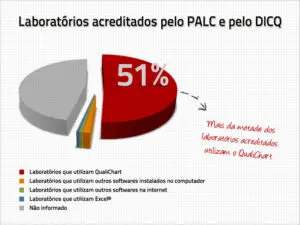
Until December 2012, a total of 215 laboratories were found accredited by the two systems, DICQ and PALC. Of this group, more than half of the laboratories carry out Internal Quality Control with QualiChart.
6- RDC 302/2005: The Regulation of Clinical Laboratories
The health regulations of Brazilian laboratories have evolved since RDC 302/2005, replaced by RDC 786/2023 and, later, by RDC 978/2025. The control organization must consider the current requirements applicable to the type of service. See the current IQC requirements.
The health assessment must consider current requirements, including RDC 978/2025 and its amendments for the services covered. Update procedures based on the consolidated text; It is not enough to change the standard number on an old document. See the current IQC requirements.
According to art. 4 of the regulation, failure to comply with the stipulated determinations constitutes an infraction of a sanitary nature. The offender is subject to prosecution and penalties provided for by law.
The Clinical Laboratory Standard

RDC 302/2005 is part of the regulatory history and addressed stages from collection to issuing reports, in addition to organization, infrastructure and biosafety. The current application must be based on the current framework. See the current IQC requirements.
To prepare the RDC 302/2005, a working group was formed that included health departments, health surveillance, laboratories, members of the Brazilian Society of Clinical Pathology/Laboratory Medicine and the Brazilian Society of
Clinical Analysis, proficiency testing providers
and a technical consultant.
For 90 days, the proposal was made available for public consultation and suggestions. The Biosoft team (maintainer of QualiChart) sent suggestions and some were honored with incorporation into the final document. Dr. Silvio Basques, scientific consultant at QualiChart, states that the public consultation, initiated by Anvisa itself, was an important factor in improving the regulation.
The document regulates laboratory activities in the areas of clinical analysis, clinical pathology and cytology.
Internal Quality Control and RDC 302/2005
Quality assurance depends on activities that are planned and executed consistently. Internal control contributes to monitoring the analytical process; criteria and records need to be defined and reviewed by the team. See the current IQC requirements.
As of the new regulations, it became mandatory for clinical laboratories carry out the daily internal quality control. According to the document, the clinical laboratory must ensure the reliability of the laboratory services provided, through at least: internal quality control and external quality control.
9.2.1 THE CLINICAL LABORATORY MUST PERFORM INTERNAL QUALITY CONTROL CONSIDERING:
A) MONITORING THE ANALYTICAL PROCESS BY ANALYSIS OF CONTROL SAMPLES, WITH RECORDING OF THE RESULTS OBTAINED AND DATA ANALYSIS;
B) DEFINITION OF RESULT ACCEPTANCE CRITERIA BY TYPE OF ANALYTE AND ACCORDING TO THE METHODOLOGY USED;
C) RELEASE OR REJECTION OF ANALYZES AFTER EVALUATION OF THE RESULTS OF CONTROL SAMPLES.
9.2.2 FOR IQC, THE CLINICAL LABORATORY MUST USE COMMERCIAL CONTROL SAMPLES, REGULARIZED WITH ANVISA/MS IN ACCORDANCE WITH CURRENT LEGISLATION.
9.2.2.1 ALTERNATIVE FORMS DESCRIBED IN THE LITERATURE CAN BE USED AS LONG AS THEY ALLOW THE EVALUATION OF THE PRECISION OF THE ANALYTICAL SYSTEM.
9.2.3 THE CLINICAL LABORATORY MUST RECORD ACTIONS TAKEN RESULTING FROM REJECTIONS OF CONTROL SAMPLE RESULTS.
9.2.4 CONTROL SAMPLES MUST BE ANALYZED IN THE SAME WAY AS PATIENT SAMPLES.
To learn more about the importance of carrying out Internal Quality Control, access our free eBook: 6 Reasons to Take Care of Internal Quality Control.