
About the author

Silvio de Almeida Basques
Author of materials on internal quality control and information systems for laboratories.
Training and experience
Doctor, with residency and postgraduate degree from the Federal University of Minas Gerais and specialist title from the Brazilian Society of Clinical Pathology. Retired professor at the UFMG Faculty of Medicine.
Presentation
Control materials, control solutions, control samples — these are several names for materials used specifically for quality control purposes and that should not be used for calibration purposes. (IFCC)
The control material is the fundamental component in the structure of the quality system in a laboratory, in the Internal Quality Control (IQC) processes.
As recommended by CLSI, the control material must have characteristics that enable it to assist the professional in verifying the performance of measurement procedures — that is, performance of the analytical system. The intention is that it can be assumed that, if the analyzes of the control material are compliant, a good result will also be obtained in the analyzes of patient samples.1
Control materials should be processed as a patient sample and should not receive special treatment in an analytical run. The result obtained must be evaluated by a process control method — which may be the Levey-Jennings chart and/or Westgard rules — before releasing the results from patient samples.
A process control method is a statistical method and applies to Quality Control of quantitative analyses. The most popular is the Levey-Jennings graph, derived from Shewhart.1
Given its importance as a reference material for judging the performance of the analytical system, the material must be treated with great care, to better achieve control purposes. In short, it is understood that serial analyzes carried out on control materials and judgment using a statistical analysis method — with defined rules — must be able to alert the professional when something is not going well with the analytical system and not alert when the system is working properly.1
Control materials, or simply called controls, are used to monitor precision. As it is a duty to always calculate its own mean and variability, the laboratory is authorized to use as a reference for analyzing its imprecision even materials without known mean and standard deviation values (unassayed). Using these materials, the laboratory will determine the mean and standard deviation values in its own environment, using them to establish the limits on the Levey-Jennings plot.
Its results can also be used to monitor accuracy, if considered a state in which accuracy has been previously defined by an effective system.
Control materials are available in Brazil with known values and contain information about the average values and the variation range proposed by the manufacturer. It is worth remembering that these values vary from batch to batch of material, which means that each new batch has its own identity. There are consistent reasons to consider that the laboratory should not judge the performance of its systems by the proposed reference (range in the manufacturer's package insert), but should instead calculate its own values to establish its acceptance limits.
Control materials are generally freeze-dried and can also be supplied frozen and liquid. When indicated, they must be strictly reconstituted in accordance with the manufacturer's recommendations. They are supplied by specific manufacturers, some with a wide range that covers a wide range of tests. Sometimes they are supplied together with equipment and reagents.

Necessary care to have good material
Stability
We can think of the concept of stability in two aspects:
- Stability guaranteed by the manufacturer — from the manufacturing process, storage and transportation under recommended conditions, to delivery to the laboratory. Developing and delivering a stable product are the manufacturer's commitments and all of its recommendations must be strictly observed.
- Stability guaranteed by the user — in the storage and use of the product, so that it preserves the characteristics it had when produced and thus fulfills its role as a reference for control.
1.1 Freeze-dried Control Reconstitution
Reconstitution is a very critical process. The inaccuracy of the volumetric material used to reconstitute or dilute the controls will be reflected in the result obtained.
The use of solvent/diluent (demineralized water, saline solution, etc.) of compromised quality, applied in reconstitution, can interfere in an unpredictable way with the results of the analyzes to which this material will be subjected.
Control results will vary from vial to vial of the same batch if reconstitution fails in any way. Therefore, this process must be well standardized and carried out by a qualified and qualified person. Class A volumetric pipette, reagent-type deionized water and manufacturer's instructions for the reconstitution process must be used.
Standardization is key. Only with processes defined with a SOP, with a clear description of the use of the volumetric pipette and other processes, can good results be achieved.
The laboratory must create a SOP that establishes the rules for storage, preparation and use of control materials, the criteria for introducing new lots of controls and reagents and that defines control limits.1
1.2 Fractionation and Storage
Fractionation for storage provides rationalization of use according to laboratory needs, preserving the stability of the entire product, especially for materials stored frozen.
The size of the aliquot in each fractionation must be established by the laboratory itself, according to its usage needs, in a rational use that considers the need for the analyzer and the costs. The aliquots must always be stored tightly sealed, under the conditions defined by the manufacturer, observing the different stability times for the different analytes.
The containers used for storage must be appropriate (cryotubes) in order to prevent concentration of the sample by evaporation of the solvent. Samples kept in containers with poor sealing, in any condition (frozen or not), suffer the effects of concentration due to solvent evaporation. Small aliquots should not be stored in large volume containers.
The identification of each rate must be rigorous. It must contain the control name, lot, level and expiration date after reconstitution. As it is difficult to apply all this information in small containers, the professional may find it useful to make records in a From → To table, which contains an acronym or code related to the data on the side.
| Acronym/Code | Description |
|---|---|
| 1LabQC | LabQualiControl level 1 — batch: 00689, expiration date Sep 2014 |
| 2LabQC | LabQualiControl level 2 — batch: 00674, expiration date Sep 2014 |
The small tube would be labeled 1LabQC and the other 2LabQC, identifying the material for level 1 and level 2, for correct positioning in the analyzer.
1.3 Freezing
More than the physical appearance of hardened material, the freezing of different preparations must be guaranteed according to the temperature recommended by the manufacturer. To achieve the stability(s) recommended by the manufacturer, storage temperatures must be strictly respected.
Apparent freezing often occurs at temperatures higher than those recommended, and there is no guarantee of preservation of the material's characteristics.
1.4 Defrost
The sample thawing process can be accelerated using a cold water bath. It should not be accelerated through heating, as this may accelerate the degradation of a component.
Care must be taken to ensure that the samples, after thawing, are adequately homogenized, avoiding excessive agitation at this time. Do not use vortex. Homogenization is more difficult for small volumes stored in small containers. A tube containing frozen material should not be opened until it has been adequately homogenized.
1.5 Sample conditions in the analyzer cuvette
The homogeneity of the sample must be guaranteed before transferring it to the analyzer. The use of non-homogeneous samples leads to inadequate results, leading to random errors. The presence of air bubbles in the control sample in the cuvette may provide incorrect results, with random errors (violation of 1:3s and R:4s rules).
1.6 Environmental exposure
Samples kept uncovered are subject to the evaporation process, which will increase the concentrations of the analytes. The intensity of evaporation depends on the environmental conditions (low relative humidity) and the container where the sample is contained (opening width of the container). Well-ventilated and/or air-conditioned environments allow sample concentration by evaporation of the solvent. The analytical run must be started as soon as the controls are uncapped and placed in the analyzer cuvettes.
Avoid leaving the vial on the bench after transferring it to the cuvette. If kept open, concentration occurs — deviation towards more, on the graph. If kept closed, degradation occurs — downward deviation.
Control residues after use by the equipment must not be returned to the original vials or even stored for reuse.
Consistency of values across bottles from the same batch
When planning for the use of control materials, one should consider purchasing sufficient volume for six months — or more, if possible — of the same batch. This is justified as a cost reduction factor, as it eliminates the need to frequently carry out the preparation phase (the laboratory's own values) in a superposition process before finalizing the batch in use. This strategy may require planning with the supplier, logistics for partial delivery or storage by the laboratory, in addition to adjustments in the payment method.
The mean and standard deviation values vary from batch to batch, even from a given manufacturer, which requires a new preparation phase to determine the laboratory's own values. So the laboratory will have several vials of materials from the same batch and it is understood that these vials will provide material with adequate stability.
It is estimated that, if there is standardization in the reconstitution process for each vial, the variation in results from vial to vial in the same batch corresponds to a small fraction of the total variation that can occur — which is almost entirely due to measurement imprecision.
This stability is ensured if the reconstitution of each vial follows strict standards, carried out with the utmost care. If there is a failure to reconstitute a vial, the product's characteristic of little variability from vial to vial is lost.
Assayed and unassayed material
Assayed control material is the most common in Brazil. It is provided with a specification of which analytes for what it was designed to control and with so-called package insert values, for average (target value) and recommended range for variation.
For quantitative, statistical internal control, the range is not suitable, making it necessary to calculate the standard deviation. The standard deviation value is fundamental to statistics and is the basis of all computer programs for IQC.
The manufacturer's values should only be used in the initial stage (preparation phase), until the laboratory's own values are determined, as they were obtained in analytical environment conditions different from those existing in the laboratory.
In a system of good quality and stability, the variability measured by the laboratory is smaller than that suggested by the range offered by the manufacturer, which is usually wide. Performing the IQC with limits within the range provided by the manufacturer (label values) is not considered a good practice, as it is based on limits that are not those of the laboratory and is therefore not very sensitive for detecting errors.
The unassayed material differs in that it does not present the manufacturer's average and range values. It can be used in the same way as assayed control material, by previously determining the laboratory values and then adopting the limits for the Levey-Jennings graph. The use of unassayed material is not yet common in Brazil.
The same method as for the use of unassayed material applies to materials produced with pool of stable serum, which would be an alternative form. It is necessary to guarantee the stability of the material used, which is a critical point of high relevance. It is necessary to highlight for stable serum pool the need to adopt precautions, as we are dealing with potentially infectious material.

Analyte concentration levels, appropriate for control
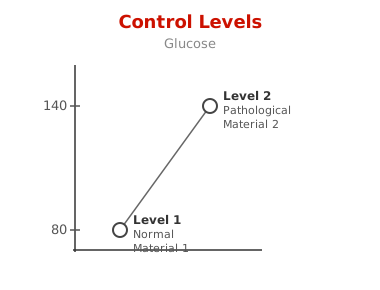
We often refer to control levels when talking about Internal Quality Control, and this has special meaning. When planning IQC, the laboratory must consider that it is important to monitor its system so that it is stable in detecting concentrations at levels of medical interest. In clinical chemistry, two levels are most often used, one at the reference range and the other at the pathological level. The CLSI2 document suggests a minimum of two levels, in general, but at other times an additional level may be necessary to adequately monitor performance, such as in hematology.
Each level of control is ensured by a material, since we are dealing with analyte concentrations. That's why two materials are needed — one for each level — if we are going to work with two levels. If we take Glucose as an example, we must have a material with a value of around 80 mg/dl (level 1) and another material with a value of around 140 mg/dl (level 2). There would then be two control determinations per day for Glucose, one in the sample of each material.
Developing IQC with at least two levels allows for greater sensitivity of the method for detecting nonconformities, as well as greater effectiveness when identifying the type of error and the root cause.
Matrix Effect
A control material, depending on the substances included in its composition, can exhibit different results compared to different methodologies, depending on the formulation of the reagents and equipment used in the measurement.
These differences occur due to the effects of the matrix used — material of human origin or other origin —, incorporated additives, freeze-drying or other processes used in its production.
It is considered that ideally the control material has the same matrix as the specimen to be tested. Materials prepared from human sources have been used, but there are cited preferences for using materials of bovine origin, given the potential for infectious risks with the former.3
There are other variables due to the specificities of the methodology that require the use of specific materials for specific techniques. An example is what can happen with CKMB through the immunoinhibition method, given the refinement of the technique. In cases like this, the laboratory must adopt control materials recommended by the reagent manufacturer.
The matrix effect cannot be eliminated, but its impact on the assessment of imprecision tends to disappear when the laboratory determines its own values in a phase before judging the performance of the analytical system — the so-called preparation phase. This reinforces the need for the laboratory to determine its own mean parameters and limits and not use the manufacturer's range as a reference to judge their systems.

Contracting with suppliers
Historical context of the revoked standard. According to RDC 302 item 9.2.2 and 9.2.2.1, the text in force at the time allowed the use of commercial control samples, regularized with ANVISA/MS, or alternative forms described in the literature as long as they allowed the assessment of the precision of the analytical system.5
The choice of supplier must take into account several factors and must be part of quality planning. The selection of materials and respective suppliers must be based on analyzes involving costs, material stability, ease of use, matrix, the analytes present in the material and the possibility of obtaining the same batch for a long period of time — if possible, for a year.
A good relationship with the supplier and the latter's forecast for its customers' material consumption will help it to have a supply plan, ensuring good service.
Some suppliers offer data analysis services, software for IQC, intra-group comparisons, etc. It is clear that the costs of software and services are added to the costs of purchased materials and these "packages" usually result in some degree of lock-in, making it mandatory to purchase the entire line from the same supplier. The laboratory will always judge whether this business model is appropriate for its IQC, or whether it will be more convenient to avoid lock-in.
Suppliers are constantly evolving in the production and availability of materials that can meet the growing control needs of laboratories. Good interaction with your supplier helps the laboratory manager to make the best choices.
Conclusion and Additional Resources
The definitions for the use of control materials must be part of strategies outlined in the laboratory's Quality Planning.
The choice of materials requires consideration of several factors and one should avoid increasing the number of materials that are used. Quality management becomes a more complex issue for laboratories that have different equipment and a very large menu of tests.
The professional must keep in mind that the control material is his reference and, if used well, it will help control analytical performance and guarantee good results from his work.
Did you like it? Share this content
Published October 2012
Bibliography
- Basques, JCA. Using Controls in the Clinical Laboratory. Labtest Diagnóstica, 2009.
- CLSI C24-A3. Statistical Quality Control for Quantitative Measurement Procedures: Principles and Definitions; Approved Guidelines-Third Edition. Clinical and Laboratory Standards Institute, Wayne, PA, USA, 2006.
- Westgard JO et al. Basic QC Practices 3rd ed. Madison WI: Westgard QC, 2010.
- Fraser CG. Generation and application of analytical goals in laboratory medicine. Ann Ist Super Sanita. 1991;27(3):369-75.
- ANVISA — Resolution of the Collegiate Board of Directors — RDC nº 302, of October 13, 2005. Provides for Technical Regulations for the operation of Clinical Laboratories.