From manual assessment to IQC monitoring
Clinical laboratories play a crucial role in the diagnosis and treatment of patients, and to ensure the accuracy of results, it is essential that the Internal Quality Control process is efficient. This is where strategies come in to ensure greater stability in the analytical system, consequently increasing the reliability of the tests performed.
In this article, we will present the success story of Laboratory Paulo C. Azevedo, which optimized its IQC process and today has more than 25 collection points in several hospitals and clinics in the State of Pará, ensuring safety through the efficiency of Internal Control.
We spoke with the Technical Manager, who has been in charge of the quality process for 23 years, Silvana Pires, who witnessed challenges when starting to implement IQC, when previously they used the data generated by the equipment and applied statistical calculations manually to evaluate the performance of the analytical system, based on the manufacturer-assigned range and Excel spreadsheets.
These methods made it impossible to validate the controls on a daily basis, because they were incomplete and insufficient and because of the quantity of analytes and equipment to be analyzed on a routine basis. They came across many errors in the control analysis, as they always depended on the intervention of a professional with scientific knowledge (higher level). The need then arose to optimize the Internal Quality Control process in the laboratory to guarantee the reliability of the results.
In 2006, the Paulo C. Azevedo Laboratory began the search for a tool to optimize IQC efficiency. They found QualiChart, and since then this has been the primary tool for test reliability.
Control registers in practice
Over the 17 years using the system, Silvana has witnessed several cases that highlighted the quality of IQC's analytical performance and recalled a specific case, where they received a question from a client about the correction of the Vitamin D dosage result. After taking the result to the doctor, the client returned to the laboratory alleging an error regarding the result of the Vitamin D test, where the value exorbitantly exceeded the normal average.
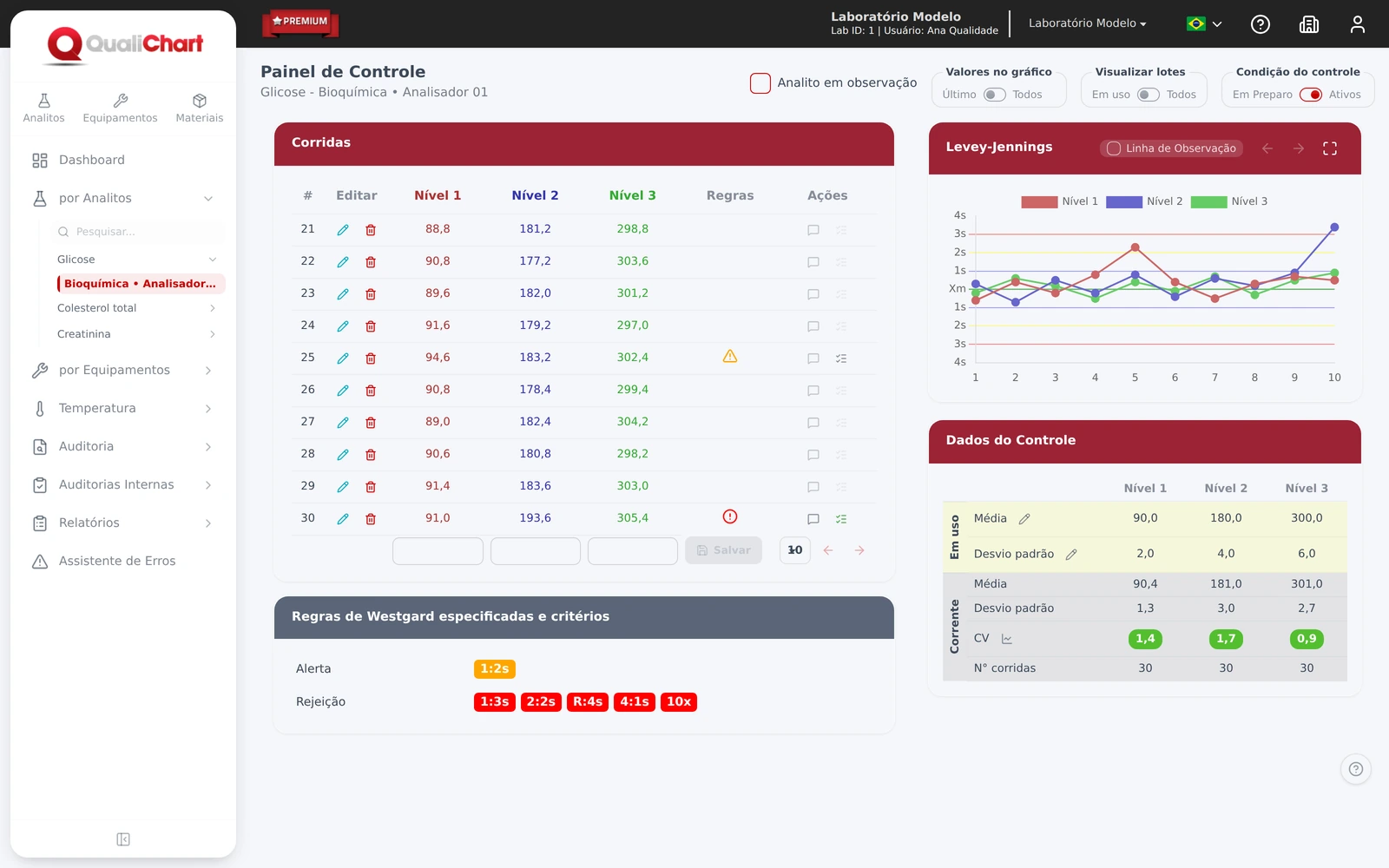
To prove the precision of the result, the laboratory team extracted reports from IQC tool for Vitamin D, with the control performance record from previous months, including analysis graphs and nonconformity treatments.
“The client had trained as a pharmacist, and because he understood a little, he was surprised by the complexity of the Internal Control process when we showed him the information and ended up apologizing for the accusations of errors on the part of our laboratory”, shared Silvana.
Finally, discovered that the high level in the client was real and due to the toxicity of the manipulated supplementary medication used, confirming the correct result for the high value of vitamin D in the report issued by the laboratory. Carrying out internal control allowed the laboratory to have confidence and ensure the quality of the results presented.
The experience of those who follow the routine
Silvana concludes by highlighting the importance of having an automated tool in the Internal Quality Control process in clinical laboratories:
" The system gave us an overview of control in all laboratory units, which makes it possible for us to anticipate problems through real-time data analysis. I highly recommend QualiChart for other laboratories. I consider it a complete and excellent tool for recording and analyzing data, mainly due to the breadth of information that is recorded.
With QualiChart, I received support and practicality to evaluate control from anywhere and consult information from the analytical system at any time.
Today I have a complete view of the influence of calibrators, trends, impacts on average control, equipment impact analysis, saving hours and hours of work to act in real time, seeing the data directly in the system.
I consider QualiChart to be the tool that best demonstrates analytical performance, detects trends in control and points out nonconformities, facilitating the analyzes we need to carry out in real time. Today it is impossible to maintain control without QualiChart.”
Get to know IQC in your laboratory routine
These are cases, such as those of the Paulo C. Azevedo Laboratory, that inspire us in our mission to ensure that every clinical laboratory can deliver results more reliably to its patients and gain greater recognition from the medical community, meeting the expectations of its patients, but also increasing their trust and credibility in the market.
We commonly talk to engaged professionals and spend our days delivering exceptional value, helping people who have been completely stuck and frustrated with IQC for months, if not years, achieve clarity and confidence in the analytical process and the results delivered. One in two of the people (50%) we spoke to ask for help implementing their new strategy.
Find out how your laboratory can guarantee greater stability in the analytical system and safe delivery of results (with 85% less time spent on the daily control routine).
Through a free demonstration we can show how our solution can help you ensure efficiency and assertiveness in your Internal Control.
Overcome the limitations of traditional methods by adopting more efficient features to improve the quality of analytical processes, facilitate decision-making and increase your confidence in patient outcomes.