
Every laboratory report carries the name of the laboratory, the name of its technical manager and the signature of a licensed professional (Arts. 166 and 167 of Brazil's RDC 978/2025). When a result is wrong, the cost does not fall only on the patient and on the physician who made a decision based on it. Brazilian law provides for fines, closure of the establishment, cancellation of the license, compensation for damages and, in serious cases, criminal prosecution. Most of these consequences do not depend on bad faith: many begin with a control that was not run or a record that does not exist.
The article Quando o exame mente: a qualidade dos laboratórios clínicos e o risco para a decisão médica, published in Portuguese on the MEDC blog, looks at the problem from the side of those who order the test: it brings together data on the quality of Brazilian laboratories and advises physicians to question results, check where they come from and report failures. This text looks at the same issue from the side of those who sign the report: what the regulation requires, what happens when it is not met and how to turn compliance into a verifiable routine.
What physicians are advised to ask the laboratory
The MEDC article starts from figures every laboratory manager should know. A survey published in 2022 found 2.3% of Brazilian clinical laboratories accredited or certified, and another, published in 2023, found 3.43%. The same 2022 study counted only 27.4% of laboratories enrolled with the two largest national proficiency testing providers, even though external quality assessment is mandatory. The article notes that there are other providers and that some of the registered establishments are collection sites, but the gap between what is required and what is practiced remains wide.
Given this picture, the advice to physicians is straightforward: treat a result that does not match the clinical picture as a hypothesis, repeat it before acting and know where the patient is tested. The article suggests asking the laboratory whether it takes part in proficiency testing and how it performed recently, whether it is accredited, who the technical manager is and whether its health license is current. In the event of a serious error or suspected fraud, it advises reporting to the local health surveillance authority, to Notivisa, Anvisa's reporting system, and to the technical manager's professional council.
For the laboratory, each of these questions calls for evidence at hand: the external quality assessment performance report, the internal quality control history, the calibration and maintenance records. A laboratory that cannot produce them puts at risk the trust of those who refer patients, even before any inspection.
What RDC 978/2025 requires and who answers for it
Anvisa's RDC 978/2025 regulates the services that perform clinical laboratory tests in Brazil. Published on June 10, 2025, it gave 90 days for compliance (Art. 191): since September 2025 its requirements have been enforceable, except for physical infrastructure items, which apply to renovations, expansions and new construction. Article 85 assigns compliance with the safety, quality and effectiveness requirements to the service's legal representative and technical manager.
The requirements related to quality control are in these articles:
- Art. 87. Quality control management must be documented, and its effectiveness monitored by the technical manager through performance indicators.
- Arts. 177 to 180. IQC on all instruments in use and for all analytes, with acceptance and rejection criteria, release or rejection of analyses and records of nonconformities, of the causes investigated and of the actions taken.
- Art. 183. IQC at least on every analytical run and after every preventive and corrective maintenance; for single-use products, on every lot change and every shipment, according to the manufacturer's instructions.
- Arts. 185 to 189. Individual EQA on all instruments and for all analytes, with an annual check of the programs available and an alternative assessment of accuracy when there is no program.
- Arts. 92 to 96. Records of preventive and corrective maintenance, verifications and calibration of instruments and, for temperature-controlled equipment, of the maximum, minimum and current temperature.
- Arts. 100 to 102. Records of the receipt of reagents and supplies with lot, transport conditions and date; use according to the manufacturer, with no revalidation after expiry.
- Arts. 115 to 118. Records kept for five years; changes with date and person responsible, preserving the original data; IQC and proficiency testing records up to date and available; documents presented whenever the health authority requests them.
- Art. 192. Failure to comply with the resolution is a health infraction under Law 6,437/1977, without prejudice to civil, administrative and criminal liability.
The last article in the table links the regulation to its consequences. An unmet requirement is not just something to improve at the next internal audit: it is a health infraction. The full picture of the resolution is in what changes in quality control with RDC 978/2025.
Fines, closure and lawsuits: what the law provides
Brazilian Law 6,437/1977 defines health infractions and their penalties. For a health service that operates contrary to legal and regulatory standards, such as RDC 978/2025, it provides for a warning, closure, cancellation of the license and a fine (Art. 10, item II). Penalties may be applied separately or together and do not exclude civil and criminal sanctions (Art. 2).
Fines from R$ 2,000 to R$ 1.5 million
The amount of the fine depends on how the infraction is classified: minor when the offender benefits from a mitigating circumstance, serious when there is one aggravating circumstance and very serious when there are two or more (Arts. 2 and 4).
| Infraction | Fine |
|---|---|
| Minor | R$ 2.000 a R$ 75.000 |
| Serious | R$ 75.000 a R$ 200.000 |
| Very serious | R$ 200.000 a R$ 1.500.000 |
The fine is doubled for repeat offenses, and the authority takes the offender's economic capacity into account. Aggravating circumstances include repeat offenses, calamitous consequences for public health, fraud or bad faith and failing to take the measures within one's reach after becoming aware of an act harmful to public health (Art. 8). Mitigating circumstances include seeking, on one's own initiative and immediately, to repair or reduce the consequences of the act (Art. 7). States and municipalities with their own health codes apply their own amounts and procedures.
This gives weight to records. A control rejection left unanswered can show that the problem was known. A recorded investigation, with corrective action and verification of effectiveness, shows that the laboratory acted.
Closure and cancellation of the license
Besides fines, the law provides for partial or total closure of the establishment, cancellation of the operating authorization and cancellation of the operating license (Art. 2). This is not a remote possibility:
- In May 2026, the health surveillance authority of Maceió closed a laboratory testing service that operated without a health permit and without a technical manager, with inadequate storage of supplies and an unhealthy environment. The establishment was cited, given 90 days to comply and faces an administrative proceeding.
- In 2024, PCS Lab Saleme, in Rio de Janeiro, was closed by the local health surveillance authority, with technical guidance from Anvisa, after false-negative HIV reports for two organ donors led to the infection of six transplant patients.
Damages: the laboratory has an obligation of result
In civil matters, Brazil's Consumer Defense Code applies. Under Article 14, a service provider is liable for damage caused by defects in the service regardless of fault. The Superior Court of Justice (STJ) applies this rule to laboratory tests: in REsp 1.426.349, its Fourth Panel held that the laboratory has an obligation of result and that an incorrect diagnosis is a defect in the service, with strict liability.
The same article of the Code states that the provider is only exempt if it proves that the defect does not exist or that the fault lies exclusively with the consumer or a third party (Art. 14, § 3). When a result is challenged, the laboratory has to show the state of the analytical system on that day: the internal quality control of the run, the calibration, the reagent lot in use, the storage temperature, the instrument maintenance. Without records, this proof is hard to produce.
Criminal and ethical liability
Article 192 of RDC 978/2025 makes clear that a health infraction does not rule out criminal liability. In the Rio de Janeiro case, a technician stated in testimony to the Civil Police that the quality control of serology, performed daily until December 2023, became weekly from January 2024 “to save on reagent kits”. The coordinator named in the testimonies denied ordering the change, and the laboratory attributed the wrong reports to human error. In October 2024, the Rio de Janeiro Public Prosecutor's Office charged six people, including partners and employees, with criminal association, bodily harm and falsification of documents. According to the prosecutor, those charged “did not hesitate to change safety protocols motivated solely by money”.
On the ethical side, reporting to the technical manager's professional council, which the MEDC article recommends to physicians in the event of serious errors, can lead to a disciplinary proceeding.
Where quality usually fails
Extreme cases draw attention, but day-to-day nonconformities are made of smaller gaps that build up until the next inspection or the next challenged result:
- Internal quality control run on only some days, instruments or analytes, when Art. 183 requires, at a minimum, a control on every analytical run.
- Rejected runs with no record of the cause investigated and the action taken, as required by Art. 180, item IV.
- Mean and standard deviation copied from the package insert, with wide limits that let relevant errors through.
- Reagents used after expiry or without a record of receipt, lot and transport conditions (Arts. 100 to 102).
- Refrigerators without temperature records (Art. 96) or with uncalibrated thermometers.
- Maintenance and calibration with no record, or recorded far from the control history (Arts. 92 to 94).
- Proficiency testing that does not cover all analytes and instruments, or unacceptable results left without investigation (Arts. 185 to 189).
- Records on paper or in spreadsheets that do not survive five years, a change of staff or an untraceable edit (Arts. 115 and 116).
None of these failures requires bad faith. They appear when control depends on memory, paper and manual checking, and when no one sees the whole laboratory at once.
How QualiChart helps meet each requirement
QualiChart is a quality control management system for clinical laboratories. It does not replace the technical manager's technical decisions, but it organizes the routine so that each requirement leaves a verifiable record and gaps show up before an inspection.
In short, each requirement has a matching feature in the system:
- IQC on every run (Arts. 179, 180 and 183). Westgard rules evaluated on save, Levey-Jennings chart, critical analysis on the run itself and an entry audit of the last 30 days.
- Acceptance criteria by analyte (Art. 180, item II). Laboratory mean and SD established during preparation, with 20 runs per level, and sigma per level with the analyte's TEa.
- Qualitative and semi-quantitative tests (Arts. 180 and 183). Result assessed as conforming or nonconforming before saving, with an acceptable range and a trend warning on the scale.
- EQA for all analytes (Arts. 185 to 189). Rounds with deadlines and alerts, review by a second person before submission, official evaluation, nonconformities with verification of effectiveness and cycle performance.
- Reagents and supplies (Arts. 100 to 102). Receipt, lot acceptance, lot recorded on every run and blocking of suspended, recalled and expired lots.
- Temperature and equipment (Arts. 92 to 96). Readings with the person responsible and the acceptable range, thermometers with certificate and expiry date, interventions with attachments.
- Technical manager's indicators (Art. 87). Dashboard with nonconformities, high CV and analytes under observation; monthly evolution of CV and sigma.
- Records for five years (Arts. 115 to 118). PDF reports by analytical system, access profiles and users blocked without losing their history.
- Written procedures (Arts. 86, 119 and 174). QC-GED with versions, approval workflows, confirmed reading and an audit trail kept for five years.
Internal quality control that does not depend on memory
Each result entered on the control panel, through entry by equipment or by file is evaluated by the Westgard rules configured for the analyte. Warnings and rejections appear on the Levey-Jennings chart as the result is entered, and the critical analysis stays on the run itself, with the causes from the Error Wizard, the corrective action and the name of the person who recorded it. The AI Assistant suggests hypotheses and next steps for the investigation; the decision remains with the team. Serology, reagent strips and other results on a scale have qualitative and semi-quantitative control, with the result assessed before saving.
The entry audit shows, for each instrument, a grid with the last 30 days and the number of runs per analyte and per day. A day without control is visible at once, without anyone having to check notebook after notebook.
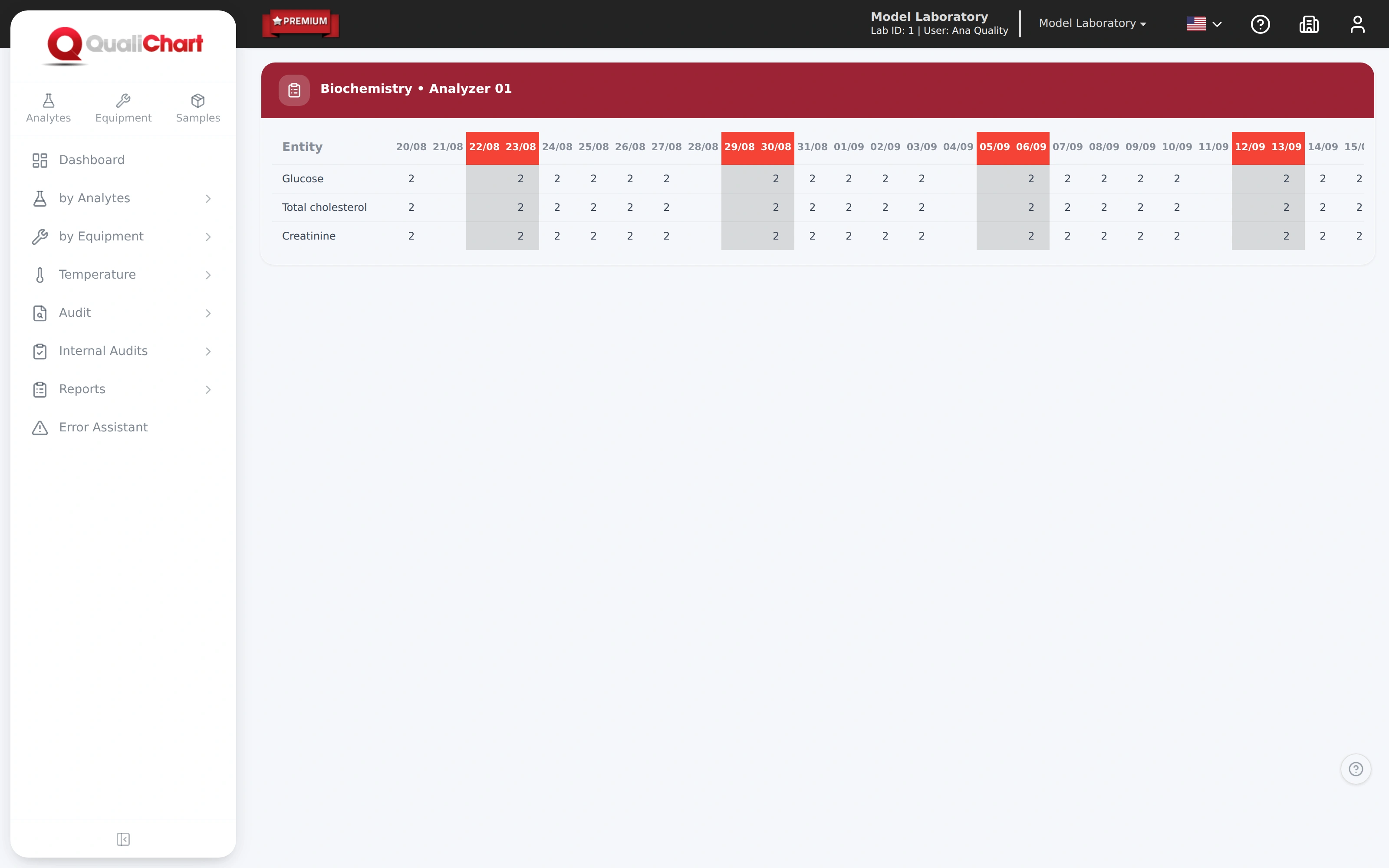
No system can prevent a deliberate decision to skip quality control. What it does is make the omission visible to the technical manager and to management while there is still time to act, and keep a record of who ran each control and when. See how quantitative IQC works in QualiChart.
External quality assessment without missed rounds
In the external quality assessment module, rounds from PNCQ, Controllab and other providers sit in the same account as your IQC, with the official calendar, daily e-mail alerts of pending items, review by a second person before submission, a copy of each version submitted and a record of the official grade. Unacceptable results open nonconformities with investigation, corrective action and verification of effectiveness, and cycle performance sits next to the provider's certificate. It is a ready answer for the physician who asks about recent proficiency testing performance. The requirements and the step-by-step process are in the complete guide to external quality assessment.
Traceable supplies, from receipt to run
Reagents, calibrators and critical consumables go through supplier qualification, receipt with the lot and arrival condition recorded, lot acceptance with a criterion defined before measurement and declaration of use. From then on, the lot is automatically recorded on every run of the control. Suspended or recalled lots are blocked for new entries, as are expired ones, unless the product record allows entries with a warning. If a lot is recalled, the impact report shows the runs that used it. See critical supplies in QualiChart.
Temperature, equipment and indicators
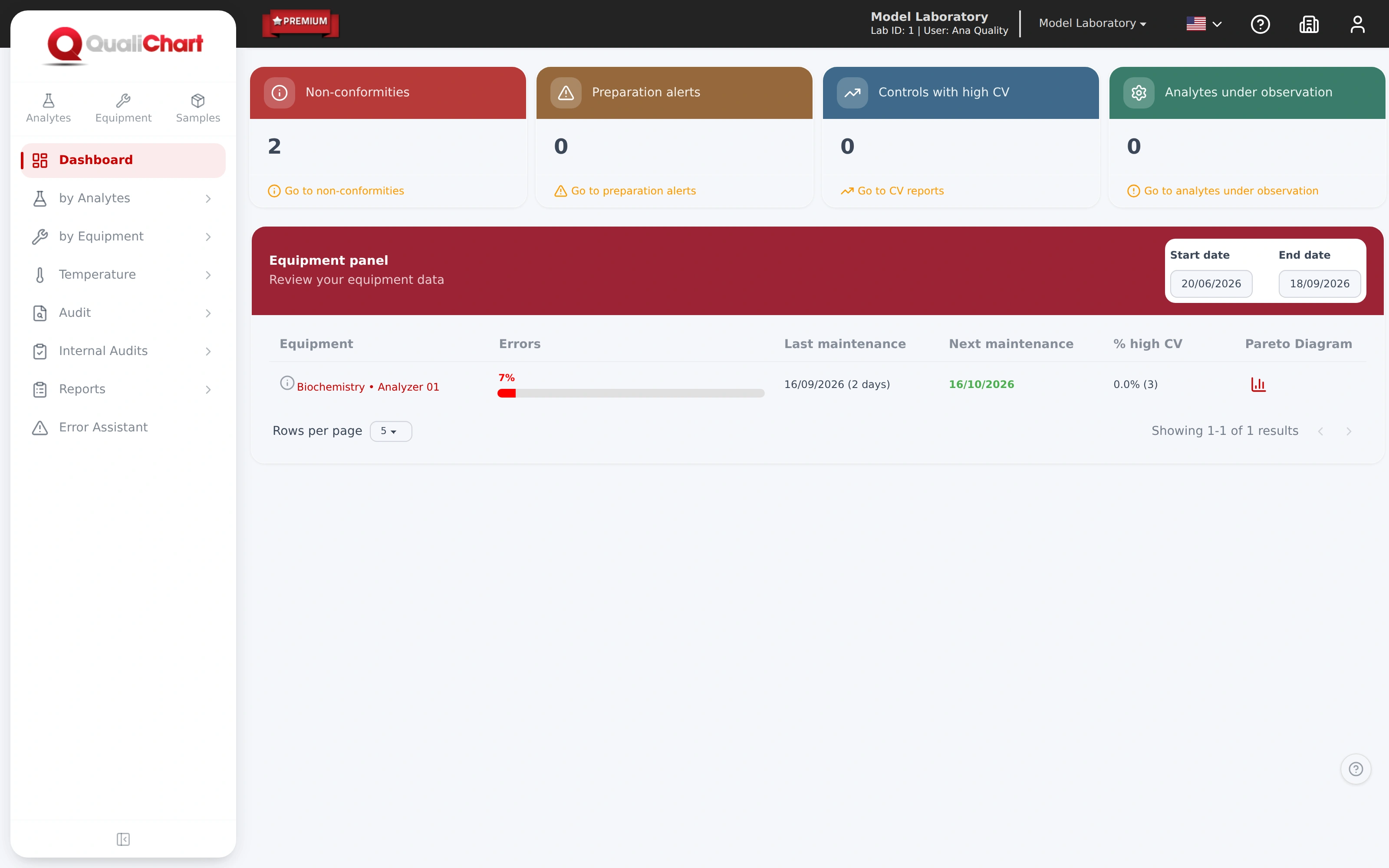
Readings from refrigerators, freezers, water baths and incubators are recorded with date, time and the person responsible, and out-of-range values are highlighted before saving. Temperature-controlled equipment keeps its thermometers with certificate and expiry date, and analyzers keep their maintenance and calibration interventions with attachments. On the dashboard, the technical manager follows nonconformities, warnings in preparation, controls with high CV and analytes under observation, a basis for the indicator-based monitoring that Art. 87 assigns to them. The monthly sigma evolution shows whether analytical performance is improving or getting worse.
Records ready when they are requested
Reports come out as PDFs with the laboratory header: active controls, preparation review, nonconformities, interventions, temperature and measurement uncertainty, as well as the critical supply and external quality assessment reports. For several analytical systems at once, the system generates a ZIP file with one PDF per analyte and instrument combination. Users who leave the laboratory are blocked without being deleted, and the history of what they did remains intact. In the critical supply and external quality assessment modules, an audit trail records changes with the author and the date. See reports and account management.
The written procedures the regulation requires, such as SOPs and control instructions, can be kept in QC-GED, QualiChart's electronic document management system, with review, approval, distribution, confirmed reading and an audit of access.
Internal audits before the inspection
The module for internal audits uses your own checklists or templates, such as the RDC 978/2025 compliance diagnosis, with evidence, scores by category and an action plan with an owner, deadline and priority for each nonconformity. It is how you find the gaps before an inspector or a lawsuit does.
What the system does not do for you
- It does not decide for the team. QualiChart applies the configured rules and flags warnings and rejections; releasing or rejecting analyses remains a recorded decision of the team, under the responsibility of the technical manager.
- It does not choose the criteria. Rules, materials, frequency and quality specifications are technical decisions of the laboratory.
- It does not grant accreditation or guarantee compliance. Compliance depends on the evidence and on the assessment of the technical manager, the auditors and the health authority.
- It does not cover what happens outside it. Pre-analytical and post-analytical errors, such as sample identification and report transcription, depend on the laboratory's processes and on its reporting system.
- In temperature control, it keeps the current reading with the instrument's range. If your procedure also requires the maximum and minimum for the period (Art. 96), keep that record according to the thermometer used.
What it does is shorten the distance between what the regulation asks for and what the routine can prove. For laboratories that need support in investigating errors and interpreting performance, QualiChart PLUS adds a scientific consultant.
Where to start
- Run the diagnosis. Answer the free IQC diagnostic roadmap, with 26 questions on RDC 978/2025 topics, and see where your routine is most exposed.
- Test it with your routine. Create an account and evaluate QualiChart free for 30 days in your laboratory routine.
- See the complete workflow. Book a demonstration of IQC, external quality assessment, critical supplies and reports applied to your laboratory.
Frequently asked questions
Can the health surveillance authority close a laboratory for quality control failures?
It can. Law 6,437/1977 provides for a warning, closure, cancellation of the license and a fine for a health service that operates contrary to regulatory standards (Art. 10, item II), and RDC 978/2025 defines non-compliance with its rules as a health infraction (Art. 192). The penalty takes into account the seriousness of the facts, the circumstances and the offender's record (Art. 6).
How much is the fine for a health infraction?
Under Law 6,437/1977, from R$ 2,000 to R$ 75,000 for minor infractions, from R$ 75,000 to R$ 200,000 for serious ones and from R$ 200,000 to R$ 1.5 million for very serious ones, doubled for repeat offenses and taking the offender's economic capacity into account. States and municipalities with their own health codes apply their own amounts.
Is the laboratory liable for a wrong result even without fault?
Yes. Under Article 14 of the Consumer Defense Code, a service provider's liability does not depend on fault, and the STJ holds that the laboratory has an obligation of result. It is only exempt if it proves that the defect does not exist or that the fault lies exclusively with the consumer or a third party.
How long must quality control records be kept?
For at least five years (Art. 115 of RDC 978/2025). Changes must include the date and the person responsible, preserving the original data (Art. 116), and IQC and proficiency testing records must be up to date and available (Art. 117, item VI).
Does IQC software guarantee compliance with RDC 978/2025?
No. The software organizes recording, evaluation and traceability and makes gaps visible, but technical definitions, decisions about runs and the assessment of compliance remain with the technical manager.
How much does QualiChart cost?
Pricing is upon request, based on the number of units and instruments. You can try the system free for 30 days before signing a contract.
References used
- MEDC. Quando o exame mente: a qualidade dos laboratórios clínicos e o risco para a decisão médica, 2026 (in Portuguese)
- Anvisa. Resolution RDC No. 978/2025, official text on Anvisalegis (in Portuguese)
- Brazil. Law No. 6,437 of August 20, 1977: infractions of federal health legislation and penalties (in Portuguese)
- Brazil. Law No. 8,078 of September 11, 1990: Consumer Defense Code (in Portuguese)
- STJ. Pesquisa Pronta highlights a ruling on liability for errors in laboratory tests (REsp 1.426.349), 2021 (in Portuguese)
- Pessoa VRA, Rios DRA. Acreditação e certificação nos laboratórios clínicos no Brasil: um panorama atual. Brazilian Journal of Health and Pharmacy, 2022 (in Portuguese)
- Pires CP, Gomes KB, Pestana RMC. Atualização do panorama das acreditações e certificações laboratoriais no Brasil. Revista Brasileira de Análises Clínicas, 2023 (in Portuguese)
- TNH1. Laboratory with irregularities closed by health surveillance in Tabuleiro do Martins, May 21, 2026 (in Portuguese)
- Agência Brasil. Laboratory claims human error in wrong HIV test results, October 14, 2024 (in Portuguese)
- SBT News. Transplant patients with HIV: technician told police that “the order was to save money” on tests, October 15, 2024 (in Portuguese)
- SBT News. Transplant patients with HIV: prosecutors charge partners and employees of the PCS Saleme laboratory, October 22, 2024 (in Portuguese)