

If you work in a laboratory, you've probably heard of control materials, the technical name for reference materials, known simply as “controls.” They are fundamental pieces in the “Internal Quality Control (IQC) Journey”, a system made up of nine steps to ensure that analytical processes work correctly and that results are delivered safely.
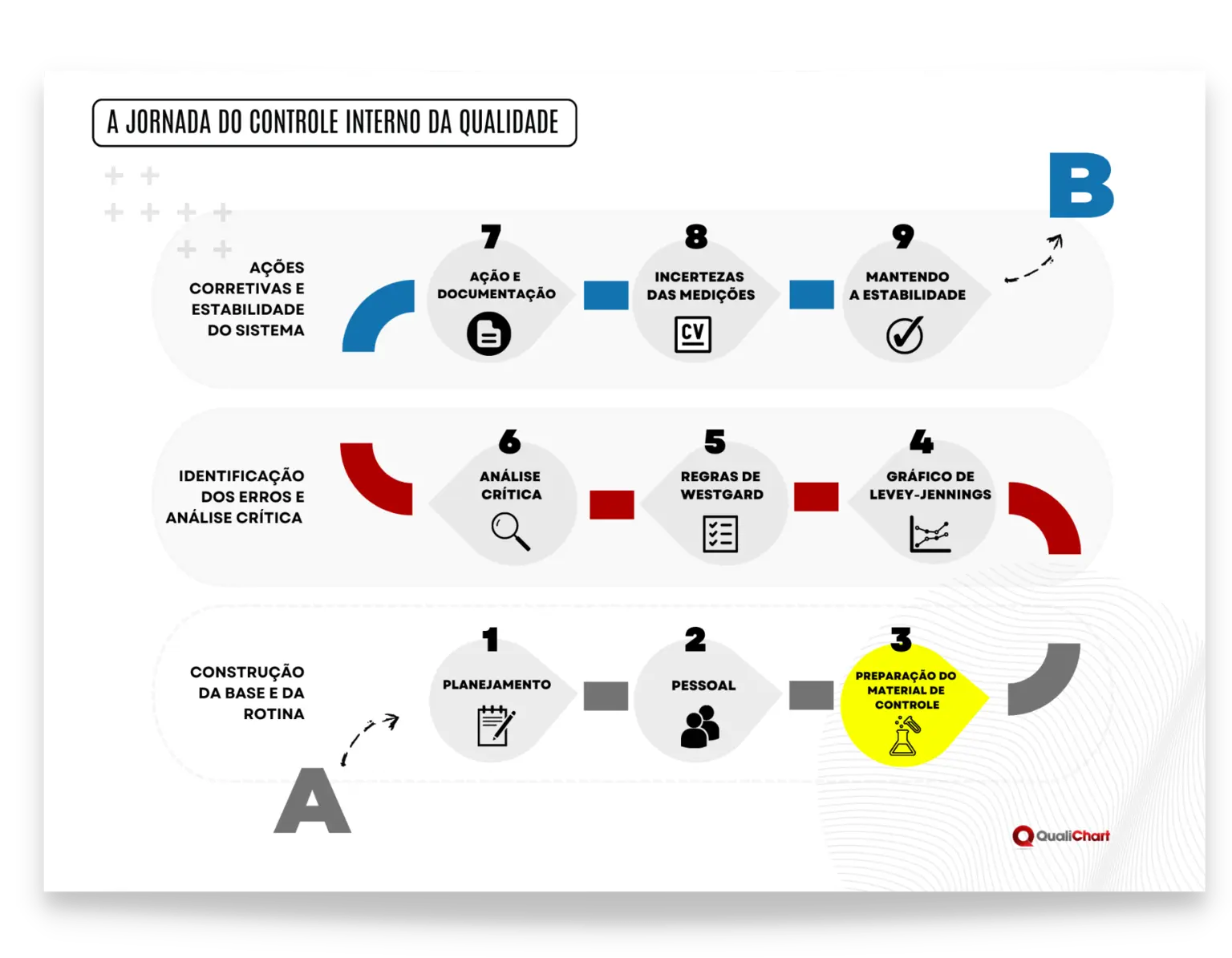
The IQC journey is an online guide that clearly and simply shows the steps necessary to face the challenges of internal quality control, such as validating control daily, performing critical analyzes correctly, applying multiple rules and managing the team and staff turnover.
The Control Material is the third stage of this journey and it is what we will talk about in this article. But if you don't yet know the other steps, you canfind out the complete guide by clicking here and have access to all the information necessary to successfully follow the IQC journey.
Now, let's delve deeper into the subject and understand why control materials are so important for the quality of laboratory results.
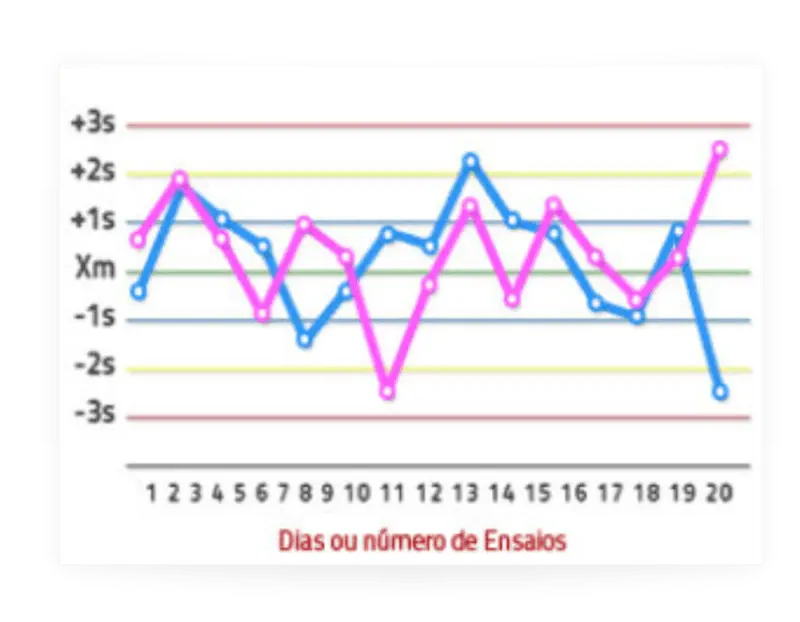
The idea is simple: if the results from the control material are within acceptable limits, then we can be confident that the results obtained from the patient sample are also correct. Therefore, it is essential to evaluate the performance of control materials with statistical methods, such as the Levey-Jennings Chart and Westgard Rules, before releasing patient sample results.
But how to choose control materials and use them in the most appropriate way?
Let's talk about the critical aspects of control materials in improving Internal Quality Control (IQC), from selection to daily use. We will cover the following steps:
- Assayed and unassayed material;
- Stability of materials;
- Consistency of values in bottles from the same batch;
- Appropriate concentration levels of analytes for control;
- Effect of the matrix used;
- The choice of suppliers.
1. Assayed and unassayed material

The assayed control material is the most common in Brazil. It comes with specifications of which analytes to control, with average values and suggested range of variation. However, the range reference is not suitable for statistical internal control, which requires the Standard Deviation (SD) as a parameter to establish limits.
The manufacturer's values should only be used in the initial phase, until the laboratory's own acceptance values, the so-called “own averages”, are collected. Carrying out internal control using package insert values is not considered a good practice, as it is not very sensitive for detecting errors and allows few assessments that are necessary to carry out good control.
Unassayed material is supplied without the mean and SD values (or sometimes the range) by the manufacturer. It can be used in the same way as assayed control material, by previously determining the laboratory values (own averages) and then adopting the limits for the Levey-Jennings graph. The use of unassayed material is not yet common in Brazil, but it has advantages because it would cost less than the assayed material.
2. Stability of materials

There are two aspects of stability of control materials: that guaranteed by the manufacturer and that which depends on the user. To ensure that the material fulfills its role as a reference for control, it is important to observe the storage and use conditions of the product.
To maintain stability, we must pay attention to the following items:
- Reconstitution of lyophilized control;
- Fractionation and storage;
- Freezing;
- Defrosting;
- Sample conditions in the analyzer cuvette;
- Environmental exposure.
Freeze-dried Control Reconstitution
Reconstitution of lyophilized control is a critical process and must be done with quality equipment and solvents to keep the control material stable. The lack of standardization can lead to variations in control results, affecting the precision of the analyses. It is recommended to follow the manufacturer's instructions and use class A volumetric pipettes, or another equal or more precise instrument, and reagent-type deionized water.
Fractionation and Storage
Fractionating control materials for storage preserves the stability of the whole product, especially for materials stored frozen. The aliquots must always be kept tightly sealed, under the conditions specified by the manufacturer. Fractions kept in containers with incorrect seals suffer the effects of concentration due to solvent evaporation. To obtain the stability recommended by the manufacturer, storage temperatures must be strictly respected.
Freezing
Freezing of different preparations must be ensured according to the temperature recommended by the manufacturer. The appearance of freezing alone, at temperatures higher than those recommended, does not guarantee the preservation of the material's characteristics. The use of suitable containers, cryotubes, is very important for preserving frozen material. Other containers do not guarantee the integrity of the material.
Defrosting
The sample thawing process must be done without heating, as this may accelerate the degradation of some component. Samples must be homogenized after thawing, avoiding excessive agitation and the use of vortex. It must be ensured to include any ice that may have remained in the lid. Only uncover when homogenization is complete.
Sample conditions in the analyzer cuvette
Before transferring a sample to the analyzer, it is important to ensure its homogeneity. The presence of air bubbles in the sample can lead to incorrect results, with random errors (violation of 1:3s and R:4s rules).
Environmental exposure
Samples kept uncovered are subject to the evaporation process, which can increase analyte concentrations. Well-ventilated and/or air-conditioned environments allow sample concentration by evaporation of the solvent. The analytical run must be started as soon as the controls are uncapped and placed in the analyzer cuvettes.
In summary, the stability of control materials is a crucial aspect to ensure the reliability of the results obtained in analytical tests.
It is important to remember that lack of care in processes involving control materials can lead to variations in results, affecting the precision of the analyses. Let’s talk more about it in the following topics…
3. Consistency of values across vials from the same batch

To ensure the stability and precision of control materials used in the laboratory, it is important to maintain consistency of values across vials from the same batch. To do this, it is recommended to purchase a large volume of the same batch, sufficient for six months or more. This is justified as a cost reduction factor, as it eliminates the need to frequently carry out the preparation phase (the laboratory's own averages).
The reconstitution of each vial must follow a strict standard, carried out with the utmost care, thus avoiding losing a characteristic of the product, given by the manufacturer, which is the little variation from vial to vial.
4. Concentration levels of appropriate analytes for control
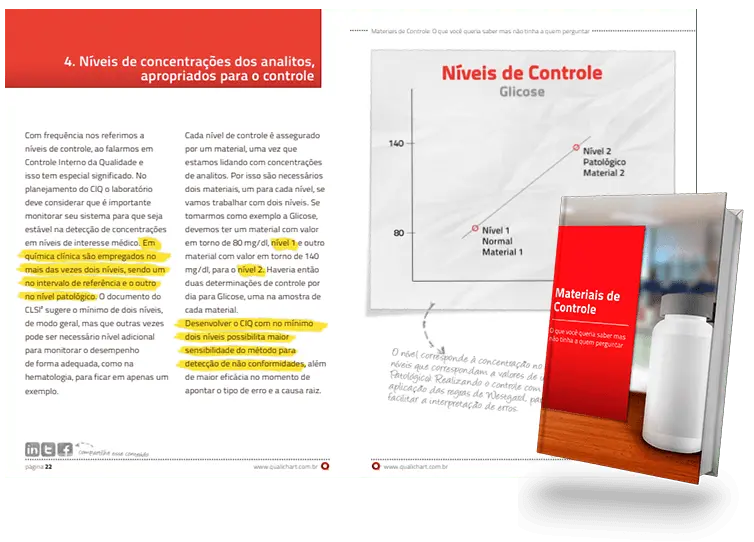
When planning IQC, the laboratory should monitor its analytical system for stability at concentrations of clinical interest. In clinical chemistry, two levels are most commonly used: one within the normal reference interval and the other at a pathological level.
Developing IQC with at least two levels allows for greater sensitivity of the method for detecting nonconformities, as well as greater effectiveness when identifying the type of error and the root cause.
5. Effects of the matrix used
A control material can present different results depending on the substances included in its composition and the methodologies used in the measurement. This is due to the effects of the matrix used, additives incorporated and other processes used in its production.
Ideally, the control material should have the same matrix as the species to be tested. The matrix effect cannot be removed, but its impact can be minimized when the laboratory determines its own reference values. This reinforces the importance of the laboratory determining its own mean parameters and limits and not using the manufacturer's range as a reference to judge their systems.
6. Choosing suppliers
Historical context of the revoked standard. According to RDC 302, the text in force at the time allowed the use of commercial control samples, regularized with ANVISA/MS, or alternative forms described in the literature as long as they allow the assessment of the precision of the analytical system.
The selection of materials and respective suppliers must be based on analyzes involving costs, material stability, ease of use, matrix, the analytes present in the material and the possibility of obtaining the same batch for a long period. A good relationship with the supplier and forecasts for material consumption help with supply planning. The choice of control materials must be part of the strategies outlined in the laboratory's Quality Planning, and it is important to avoid, whenever possible, increasing the number of materials used. The control material is an important reference for controlling analytical performance and ensuring accurate results.
Conclusion
In summary, internal quality control is a fundamental part of the quality system in a clinical laboratory. The control material plays an important role in ensuring the quality of test results performed by the laboratory. It is essential to follow recommended procedures for stability, reconstitution, fractionation, processing, thawing, and support conditions to ensure consistency of test result values. Furthermore, it is important to consider the effect of the matrix and choose suppliers within compliance with the requirements to guarantee the quality of the control material used.
We provide a free eBook which is a complete guide to deepen your knowledge and learn how to use them correctly in your laboratory.
Furthermore, the eBook completely explains how to use control materials to monitor analytical systems, as well as how to collect the laboratory's own Mean and Standard Deviation values. This is critical to establishing acceptability limits for patient analyses.
Don't miss the opportunity to improve your knowledge and improve the quality of processes in your laboratory. Access our free eBook nowand start applying these valuable techniques in your routine.
Authorship:
Prof. Silvio de A. Basques
Frida Alves Basques