
Digital transformation has revolutionized the way of solving problems in companies in all sectors, where process automation has become indispensable with the implementation of new technologies, increasing the competitiveness of companies in the market, reducing costs and optimizing professionals' time when carrying out tasks.
There are demands at all stages of the processes in the clinical laboratory, from service to delivery of results to the patient, and when it comes to internal control, process automation brings more security and significant gains in the quality of the reports issued.
To prepare a report, the laboratory is subject to several variables, such as the control method used, reagents, equipment and work procedures of professionals, which can lead to errors during .
The laboratory that does not adopt automation in internal control works with low efficiency, in addition to increasing costs, it loses customers due to the low quality of the results delivered. The risks are evident, such as:
- Lack of standardization of control processes, which hinders the provision of quality services;
- High operational costs and low personal productivity, since employees require a lot of time to carry out the control verification steps.
- Reduced patient safety, since there is a greater chance of errors and delays in delivering results;
The automation of internal control has brought clinical laboratories a significant increase in productivity, a reduction in time spent on analysis, fewer chances of errors in operations, generating cost efficiency and reducing patient care time.
Daily validation of controls
When it comes to Internal Quality Control, many laboratories report to us the difficulty in carrying out the daily validation of controls, due to the large quantity of analytes and equipment to be analyzed.
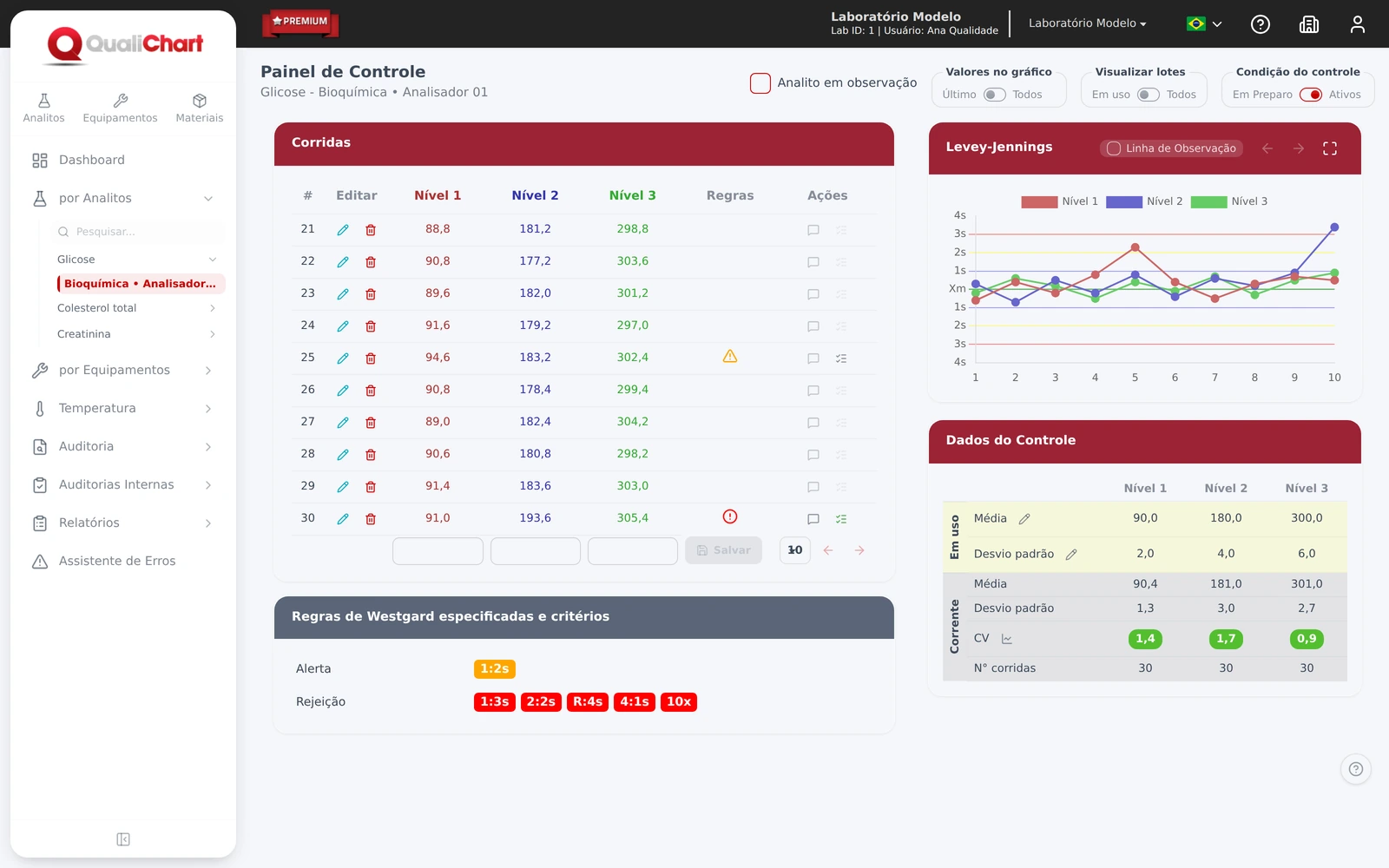
A system like this guarantees monitoring in one place of routine data from all monitored equipment and units, in addition to automatically testing the Westgard rules for all analytes, launches non-compliance alerts, classifies the type of error and searches for the root cause for solution note.
Furthermore, informing the results of the analytical runs, the system generates the Levey-Jennings graph automatically, making it possible to find deviations, trends and randomness in the laboratory's analytical system.
Cost reduction
With automation, the laboratory can perform a large number of analytical tests, eliminating most manual work. Furthermore, it guarantees more precision and accuracy, avoiding human interference, bringing agility in releasing results, generating a large increase in productivity, reducing the need to increase the team of collaborators.
All of this will lead to greater profitability for the laboratory, improving the quality of services and increasing demand for service, as good service and quality results will increase the laboratory's reputation, attracting more customers, and also facilitating the process of
Traceability
Records need to allow retrieving history and understanding routine decisions. For current health requirements for covered services, see RDC 978/2025 and its amendments; article 7.1 of RDC 302/2005 belongs to the revoked text. See the current IQC requirements.
A complete system like QualiChart provides various types of traceability, increasing quality and safety levels, presenting functionalities that display all actions performed in the analytical phase, and being able to offer a history of activities.
This process helps to manage the performance of analytical systems, collecting indicator elements to approve or challenge equipment and reagents.
Compliance with standards and accreditation
Health accreditation and licensing have different purposes and processes. Evaluate the current requirements of the chosen program and applicable regulations; Certification does not automatically result from the use of software. See the current IQC requirements.
Without automation of internal control, the manager runs a great risk when carrying out activities, resulting in fines that could make the business unviable.
Brazil has several accreditation bodies, but the most suitable for laboratories are:
- PALC: Clinical Laboratory Accreditation Program. Belongs to the Brazilian Society of Clinical Pathology/Laboratory Medicine (SBPC/ML);
PALC Requirement for Internal Control – REQUIREMENTS 11.1 TO 11.9:
11.2 – THE INTERNAL QUALITY CONTROL PROGRAM (PCIQ) MUST COMPREHENSIVELY AND DETAILY INCLUDE THE INTERNAL QUALITY CONTROL SYSTEM FOR ALL QUALITATIVE AND QUANTITATIVE ANALYZES CARRIED OUT. THE PROGRAM MUST ENABLE THE INVESTIGATION OF ALL CAUSES OF VARIABILITY THAT MAY OCCUR IN EACH ANALYTICAL SYSTEM.
- DICQ: National Accreditation System. It belongs to the Brazilian Society of Clinical Analysis (SBAC).
DICQ Requirement for Internal Control:
5.1.1 – THE CLINICAL LABORATORY MUST HAVE A QUALITY PROCEDURE DETERMINING THE GUIDELINES FOR AN INTERNAL QUALITY CONTROL PROGRAM COVERING ALL ANALYTES PERFORMED.
Therefore, automating processes facilitates control and generates security to have conviction in assuring clinicians of the value of the results of the tests delivered, in addition to being considered legal support in cases of legal challenges.
Data Logging and Reporting
A good Internal Control automation system allows the recording of data from the analytical environment, speeding up compliance with Anvisa requirements and accreditation programs.
With so many processes in the laboratory routine, preparing reports and recording data manually requires a lot of team time, in addition to being subject to errors.
In the case of an ANVISA visit or audit, several data that must be presented the laboratory may not have, because carrying out the control manually, such as by manufacturer-assigned range or Excel spreadsheets, it is complex to guarantee the record of the entire process, in addition to not being able to achieve a complete analysis of the IQC.
With cloud computing, in addition to issuing reports immediately, the reports contain data from analytical runs with possible non-conformities and observations, in addition to presenting the graphs that contribute to the analysis of controls.
Facilitate the analysis process and free yourself from all the calculation work, in addition to meeting the requirements of RDC 978/2025 ANVISA and accreditation programs with QualiChart.
Request a demo to learn about all the platform's features and see how you can increase efficiency in Internal Control in your laboratory.