What needs to be checked?
Before incorporating a method into routine practice, the laboratory needs to assess whether the demonstrated performance is adequate for local conditions and intended use. The study must have a defined scope; it is not enough to observe a control run within limits.
Prepare the study
- Describe the method, equipment, matrix, range and intended application.
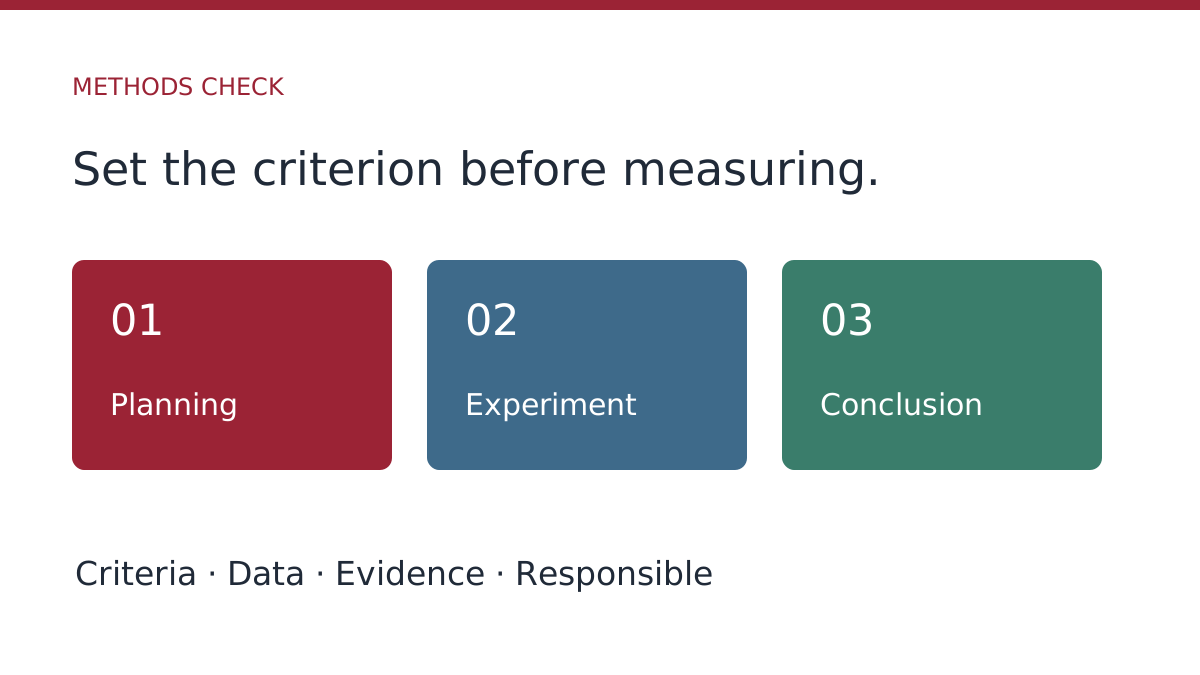
- Define which characteristics will be checked and the acceptance criteria before collecting the results.
- Select materials and samples appropriate to the purpose, considering their limitations.
- Document the experimental design, responsible parties and execution conditions.
- Analyze results, investigate discrepancies, and record the release decision.
Don't confuse steps
Calibration, internal control and performance verification have different objectives. A valid calibration does not, by itself, demonstrate all performance characteristics. Likewise, IQC monitors the stability of the routine, but does not replace the entire initial study.
Stay connected to your routine
After deployment, use IQC and CEQ data to track performance and document relevant changes. Changes in method or conditions may require new studies depending on the extent of the change.
The design and size of the study must follow the technical procedure adopted and the guidance applicable to the method. Reference: EFLM: quality assessment of an analytical method. Also explore external quality control.
Build the plan before producing results
A check starts with the performance claim you want to examine. Specify material, concentrations, days, replicates, equipment, team, environmental conditions and acceptance criteria. Setting the criteria after looking at the results makes the conclusion vulnerable to convenient data selection.
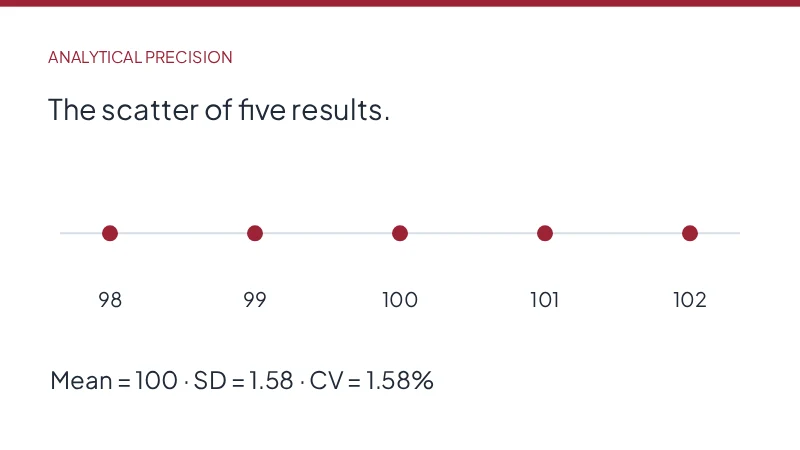
Teaching example: To investigate precision at two levels, organize results by day and replicate, maintain the link to batch and calibration, and separately examine within-day and between-day dispersion. The number of days and replicates must follow the chosen protocol; This example does not replace a validated experimental design.
When compared with another procedure, high correlation alone does not demonstrate agreement. Two methods can follow the same sample variation and still present a relevant systematic difference. Assess differences across the range and clinical decision points.
The report should allow us to reconstruct the conclusion
| Part | Question answered |
|---|---|
| Purpose and scope | What performance, matrix and range were evaluated? |
| Protocol | How were the data obtained and which criteria were already defined? |
| Results | What data, calculations and exclusions support the assessment? |
| Conclusion | Is the intended use covered? Are there limitations or pending actions? |
| Approval | Who reviewed and authorized the adoption in the laboratory? |
The check does not end on the approved file. internal quality control monitors routine performance. Material changes in method or conditions may require reevaluation. Also maintain the connection with the uncertainty estimate and the external evaluation.