
With the publication of Resolution RDC 978/2025 by ANVISA, Internal Quality Control (IQC) assumes an even more prominent role in the laboratory routine. This new regulation establishes more rigorous and structured requirements for control management, ensuring the quality of analytical processes and greater precision of results.
In this article we will cover in detail the essential steps for building a solid foundation and implementing an IQC routine, so that your laboratory complies with RDC 978/2025.
You should already have the 9-step Internal Control system and its necessary tools to achieve greater stability in the analytical system and security in delivering results (with 85% less time spent on the daily control routine) – if not, click here and access.
Therefore, we have prepared a simple guide to help you understand the practical process of the first phase of the IQC Journey: Construction of the Base and Internal Quality Control Routine. At the end of this content we provide the link to read the complete guide online.
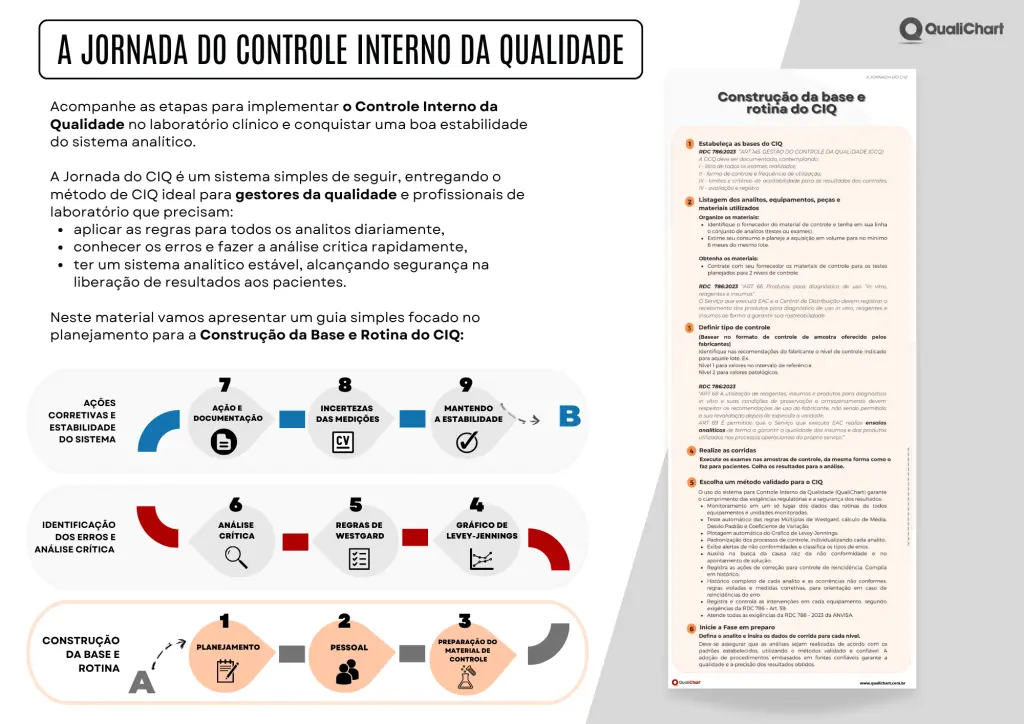
Step 1: Lay IQC Foundation
The critical first step is to lay the solid foundation of IQC. This implies defining the type of control that will be used. According to the quality control requirements of RDC 978/2025, GCQ must be meticulously documented, including a comprehensive list of all tests performed, the form of control and the frequency of use. Furthermore, it is necessary to establish limits and acceptability criteria for control results and, crucially, evaluate and record these aspects. Complete and systematic documentation is essential to demonstrate compliance with regulatory requirements. Avoid forms and papers. Adopt automated models with extensive use of IT.
Step 2: List of Analytes, Equipment, Parts and Materials Used
One of the pillars of effective IQC is the detailed listing of all analytes, equipment, parts and materials used in the laboratory. This includes identifying the supplier of the control material and ensuring that this material contains the appropriate set of analytes to cover all tests or examinations performed in the laboratory. Try to estimate the consumption of materials and plan the acquisition of sufficient volume for a minimum period of 6 months from the same batch. It is a best practice to ensure consistency of results and reduce your costs. Furthermore, it is important to contract with the supplier the control materials necessary for the planned tests in at least 2 control levels, for Biochemistry and 3 levels for Hematology.
RDC 978/2025 also highlights the importance of recording the receipt of products for in vitro diagnostic use, reagents and supplies, ensuring their traceability. Therefore, effective organization and documentation play a key role in regulatory compliance.
Step 3: Set the Control Type
The choice of material and control levels must consider the method, the manufacturer's instructions and laboratory planning. The levels must allow performance to be assessed at concentrations relevant to the use of the test. The control material must be analyzed in the same way as the patient sample, in accordance with art. 182 of RDC 978/2025.
Step 4: Perform the Runs
Once IQC foundations have been established, we begin the preparation phase, which involves defining the analyte and inserting run data for each control level.
This implies carrying out tests on control samples in the same way as they would be carried out on patients. The results obtained during these runs are essential for monitoring the performance of analytical processes and identifying possible deviations or variations. The literature also recommends that manufacturers of control materials carry out calculations of the laboratory's own averages (mean and standard deviation) and that the initial values in the package insert are used only as an initial reference at the start of each batch.
It is imperative to ensure that analyzes are carried out in accordance with the SOP, using the validated and reliable method. The adoption of procedures based on reliable sources is essential to guarantee the quality and precision of the results obtained.
Step 5: Choose an IQC Validated Method
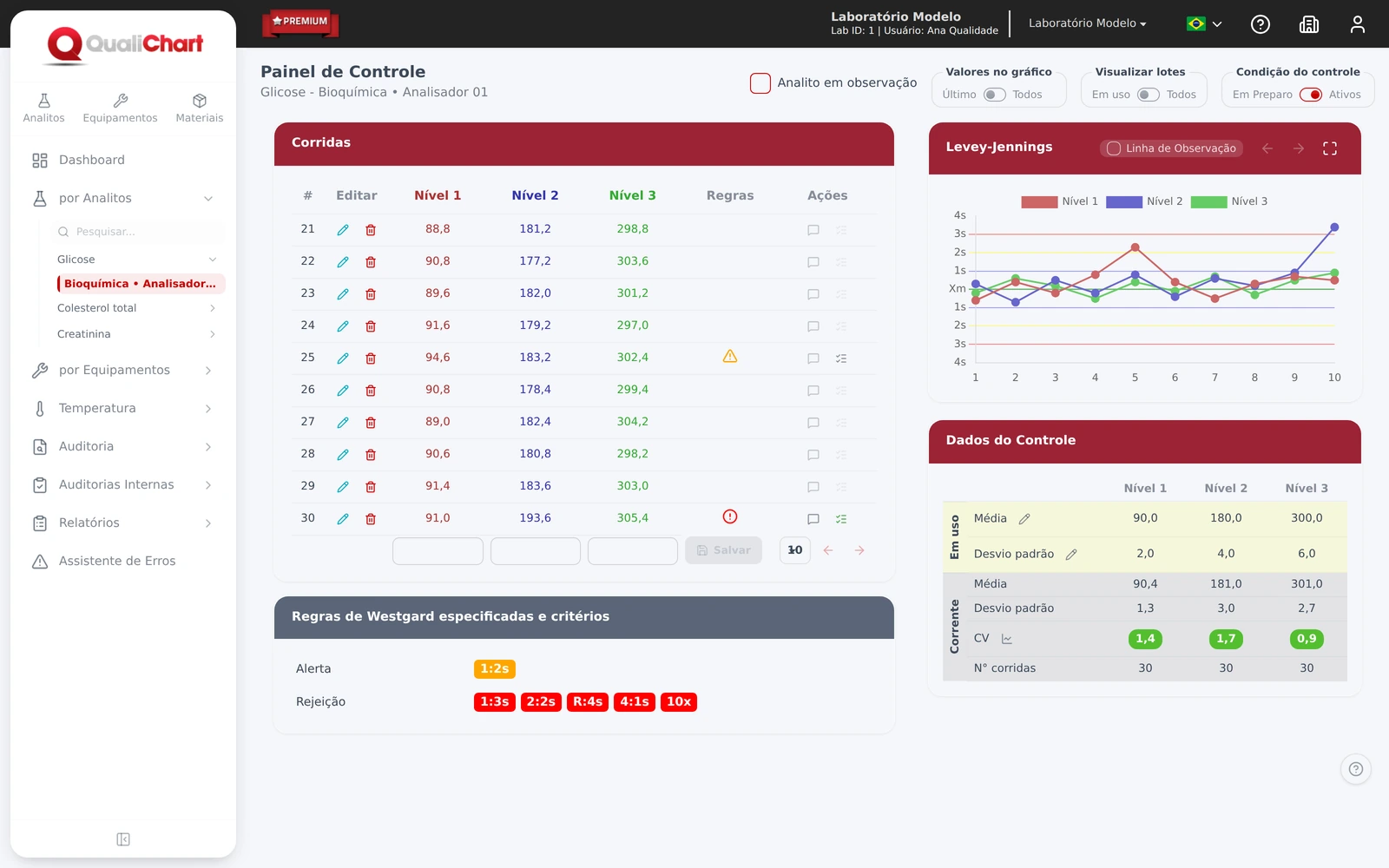
Choosing a validated method for IQC is one of the main drivers of compliance with RDC 978/2025. The use of a dedicated system for Internal Quality Control, such as QualiChart, offers a series of advantages as it is a tool that allows centralized monitoring of control data from all equipment. Performs all calculations, saving the user a lot of work. It performs daily checks based on Westgard's Multiple rules, calculates crucial statistical parameters such as Mean, Standard Deviation and Coefficient of Variation, and automatically generates Levey-Jennings Charts, among other features.
Additionally, simplifies the standardization of control processes, individualizing each analyte and displaying nonconformity alerts, classifying the types of errors and facilitating critical analysis to search for the root cause of nonconformities. Then, recording corrective actions to control recurrences, as well as compiling them into complete records and reports, are essential aspects of effective IQC management.
Adopting an efficient IQC tool is, therefore, a strategic choice that simplifies processes, optimizes IQC management and ensures compliance with the requirements of RDC 978/2025.
In summary, building IQC foundation and routine in accordance with RDC 978/2025 requires a meticulous and systematic approach on the part of clinical laboratories. In addition to meeting regulatory obligations, this practice results in a substantial improvement in the quality of services provided, reflecting the trust of patients and doctors. The use of specialized tools, such as QualiChart, plays a fundamental role in this process, providing efficiency and compliance.
Remember that RDC 978/2025 is in force from 06/10/2025, with a period of 90 days for adaptation. Therefore, it is essential to start building your IQC foundation and routine as soon as possible to ensure compliance and excellence in your services.
To assist in this process, we provide a valuable resource: a complete guide on the Construction of the IQC Base and Routine, aligned with the requirements of Anvisa's RDC 978/2025.
This material is especially relevant for laboratories that face challenges in applying Internal Quality Control and daily validation of quantitative tests, providing an accurate critical analysis to ensure the safety and reliability of the results delivered.
To access this special resource,access the complete guide by clicking on the link below: Construction of the Base and Routine of Internal Quality Control.
The pursuit of compliance is not only a regulatory requirement, but also a commitment to the health and well-being of patients who depend on accurate and reliable laboratory results.