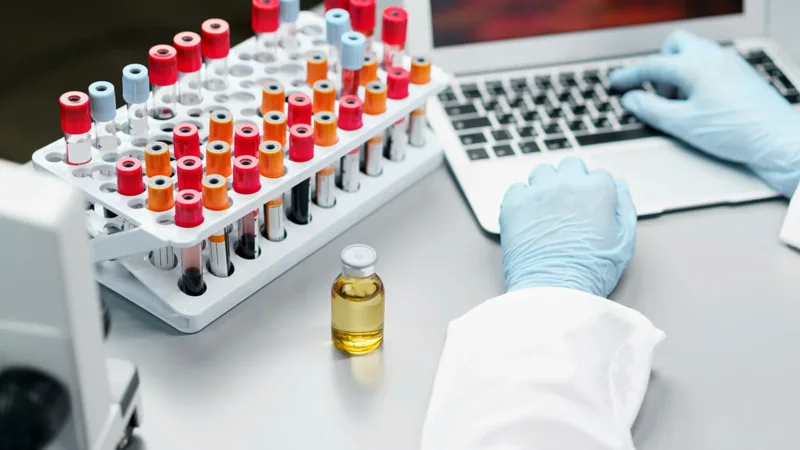
The guide to IQC
Check out the explanatory guide on Internal Quality Control (IQC) in the clinical laboratory.
In the material you will find essential information that will improve the quality of the analyzes carried out in your laboratory:
- – What is Internal Quality Control?
- – The importance of Internal Quality Control in the clinical laboratory
- – Internal Quality Control in accordance with RDC 978/2025 ANVISA
- – Impact of IQC on Clinical Laboratory for Regulatory Compliance
- – Benefits of IQC for the laboratory
- – Methods for internal quality control
- – How to ensure effective IQC
Fundamentals
What is the Internal Quality Control?
Definition
Internal Quality Control is a set of processes that aims to ensure the laboratory's compliance with the standards established by ANVISA. Its main objective is to identify, prevent and correct problems that could compromise the quality of the tests delivered.
Importance
IQC is essential for maintaining the quality of laboratory tests, ensuring patient safety and avoiding incorrect reports.
Application
IQC must be applied in human and veterinary medicine laboratories, seeking to ensure confidence in the results delivered.
Why It Matters
The importance of Internal Quality Control in clinical laboratory
A worldwide estimate, made by Labs are Vital™, indicates that around 70% of the most important medical decisions are based on laboratory reports.
Therefore, internal quality control must be part of the test routine to ensure that the final result is as accurate as possible.
Legislation
Internal Quality Control according to RDC 978/2025 ANVISA
RDC 978/2025 revokes RDC 786/2023 and is in force from 06/10/2025, with a period of 90 days for adaptation of clinical laboratories.
Chapter VII — Quality Control Management (GCQ)
Art. 171. The Service must ensure the reliability of the EAC through GCQ.
Art. 172. GCQ comprises, at a minimum, Internal Quality Control (IQC) and External Quality Control (CEQ).
Art. 173. The IQC and CEQ must be carried out exclusively in the Service that carries out the EAC (on site).
Art. 176. The GCQ documentation must include: I — list of all tests carried out; II — form of control and frequency of use; III — limits and acceptability criteria for control results; IV — evaluation and recording of control results; V — annual CEQ performance report provided by the Proficiency Testing Provider.
Chapter VII — Section I — Internal Quality Control (IQC)
Art. 177. All Services must participate in IQC programs.
Art. 180. The IQC must cover all analyzed analytes, covering: I — monitoring the analytical phase by analyzing the control sample, with recording of the result obtained and data analysis; II — definition of criteria for acceptance and rejection of results by type of analyte and according to the methodology used; III — release or rejection of analyzes after evaluating the results of control samples; IV — investigation of inadequacies with recording of the causes and corrective actions taken; V — criteria for evaluating and recording the results of Quality Controls.
Art. 183. For the EAC carried out with single-use in vitro diagnostic products, IQC must be carried out, at least, at each batch change, with each shipment and in accordance with the manufacturer's instructions. For EAC carried out with equipment, IQC must be carried out after preventive and corrective maintenance.
Chapter VII — Section II — External Quality Control (CEQ)
Art. 185. All Services must participate in CEQ programs.
Art. 189. The Service must verify the minimum annual availability of proficiency testing for tests carried out with Proficiency Testing Providers. For tests not included in CEQ Programs, the Service must adopt alternative ways of evaluating the accuracy of the analytical system described in scientific literature.
Impact
Impact of IQC in the clinical laboratory for regulatory compliance
Guaranteeing patient satisfaction
More accurate and reliable results reduce the need for rework or additional tests, avoiding delays in diagnosing and treating patients.
Improvements in the quality of results
The implementation of IQC helps identify problems in the analysis process, correcting possible errors and ensuring more accurate results.
Regulatory Compliance
The implementation of IQC is mandatory by ANVISA, ensuring compliance with regulatory standards and avoiding legal and financial sanctions.
Advantages
Benefits IQC for laboratory
Continuous improvement
IQC promotes a culture of continuous improvement in laboratories, encouraging the search for increasingly efficient and safe processes.
Cost reduction
By reducing errors and improving efficiency in the analysis process, IQC can help reduce laboratory operating costs.
Greater competitiveness
Laboratories that implement IQC gain credibility and reliability, which can help attract more patients and increase competitiveness in the market.
Approaches
methods for internal control
Manufacturer's Stated Range
The package insert range is an IQC method that consists of checking whether the results obtained by laboratory equipment are within the specifications of the manufacturer's reference range.
LIS / Equipment
Some equipment provides built-in internal control systems.
Spreadsheets
Spreadsheets are used both for recording and interpreting the results obtained.
System for IQC
Specialized systems are available on the market to facilitate the implementation and management of IQC, making the process more agile and secure.
Method 1
I perform good internal control if I use the manufacturer's stated range?
The manufacturers themselves call attention to the laboratory using the values only at an initial stage and defining its own mean and standard deviation to establish its control limits.
Even with this caveat, there are still laboratories that perform IQC only with the range analysis provided by the manufacturer and not with the values determined from their own analytical environment.
Manufacturers provide in the leaflets of their materials a table with values for each analyte, with the minimum and maximum "desirable" for the value obtained from the analysis.
Some challenges then arise...
Limitations
What do I lose by using the manufacturer's stated range?
Levey-Jennings Plot
Does not find trends and other changes by creating and analyzing the Levey-Jennings chart.
Coefficient of Variation
Comparative analysis of laboratory imprecision, measured by the Coefficient of Variation, is compromised.
Continuous Recording and Analysis
Day-to-day recording and analysis are hampered as data is not noted down effectively.
Westgard Rules
Tests of IQC's multiple rules, the Westgard Rules, which indicate the need for action according to the type of error found.
Pathological Level
More suitable analysis data when, for example, the analytical system is compromised at a pathological level and is not at the normal level.
Reports for VISA
Does not normally create and store Internal Quality Control reports required by Health Surveillance.
Method 2
A Spreadsheet Is useful as a control method in the Clinical Laboratory?
What was overlooked is that IQC requires daily action for numerous analytes, together with data entry, analysis and reporting processes…
Some IQC scholars realized that they could build spreadsheets, which, if well fed with statistical functions, would provide the necessary results to be used to judge the stability of the analytical system, at a low cost.
It was also not considered that processes necessary for IQC are still too complex to be achieved in spreadsheet format.
There is then the risk of abandoning control, because the results obtained are insufficient, despite great effort.
Some challenges then arise...
Limitations
What do I lose by using SPREADSHEET?
Numerous quantitative tests
The professional is unable to handle the numerous quantitative tests with records and reports.
Review of all controls
It is challenging to critically analyze all controls, interpreting the data correctly for decision making.
Multiple control levels
It is still very difficult to adequately handle more than one level of control.
Levey-Jennings Plots
There are no Levey-Jennings plots.
Westgard Rules
Tests of IQC's multiple rules, the Westgard Rules, which indicate the need for action according to the type of error found.
Reports for VISA
Does not normally store Internal Quality Control reports required by Health Surveillance.
Method 3
I do good internal control with non-dedicated software (LIS, Equipment)?
There are many pieces of equipment with different control software, so we usually ask the professionals we talk to some questions that represent the practice of good control:
Try to answer with YES, or NO:
- Does the equipment allow you to use the package insert data in one phase and then start using your own values for limits on the Levey-Jennings graph?
- Does the equipment software exclude out-of-control runs (outliers) from the series for calculating current values?
- Do you receive comparisons with CV values and maximum imprecision, to evaluate your own imprecision?
- Can you record occurrences and interventions in the system, related to analytical runs?
- Do you have sequential assessments for systematic error detection (10x rule) for consecutive days?
- Can you specify different rule sets for different analytes on the same instrument?
- Can you consult the history of the analyte and check previous outlier runs and what corrective measures were taken?
- If the laboratory has manual techniques for quantitative tests, can you handle the IQC data from these tests in a practical and correct way?
- Can you issue IQC reports, for periods and for long periods of time, to demonstrate to the Health Surveillance?
- Can you access data from all your equipment (Biochemistry, Hematology, Hormones, Blood Gas, Immunology) from different locations, from your room, or even from another building, from another technical area?
0 NOT answered
If you answered NO to three or more of these questions, you will certainly not be doing good control.
Some challenges then arise...
Limitations
What do I lose by using non-dedicated software (LIS, Equipment)?
Centralized monitoring
Cannot monitor routine data from all monitored equipment and units in one place.
Controls Review
It is challenging to critically analyze all controls, interpreting the data correctly for decision making.
The solution
How to ensure effective control using a System for IQC?
The implementation of RDC 978/2025 can bring challenges for laboratories, especially with the collection of fragmented data from equipment. This can make it difficult to validate controls on a daily basis and identify problems, compromising compliance with regulations.
The good news is that there are Internal Quality Control tools available to simplify this process, offering benefits that ensure compliance and efficiency.
The first Brazilian software for Statistical Control of Analytical Processes for Internal Quality Control.
The solution used by more than 1,400 laboratories across Brazil
Automated analysis
Have a full review of all analytes with the rules applied automatically
Features
Manage from simple shape all analytical environment, equipment and units in a single system
Nonconformity alerts
Receive alerts for nonconformities according to multiple rules. QualiChart tests Westgard's rules, launches alerts, classifies the type of error and searches for the root cause to identify a solution.
Deviations and trends
Find deviations, trends and randomness in the analytical system. Report the results of analytical runs and have the Levey-Jennings graph automatically.
Automatic calculations
Free yourself from all the calculation work. Automatically calculate the mean, standard deviation and coefficient of variation of entered data for all analytical runs.
More features
We collect the data, point out errors and show the path to solution
Support and Review
Ensure support in staff rotation and critical analysis of the performance trends of your analytical system, interpreting measurement uncertainty and defining correction actions.
Regulatory Compliance
Meet the requirements of ANVISA and Accreditation programs. Monitor quantitative analytical processes, record actions and histories to help deal with requirements.
Complete Reports
Issue complete reports and demonstrate control. Complete history of each analyte and non-conforming occurrences, violated rules and corrective measures, to guide you in case of error recurrence.
Next step
Schedule a free demo
Discover all the platform's features and see how you can increase efficiency in Internal Control.
We will apply real data from your laboratory and carry out the first analyses together while getting to know the system.
Schedule DemoPhone
(31) 2626-1101
(11) 3136-2334